Most online stores don’t have a traffic problem or an ads problem. They have a priority problem. They run ads before the product page converts, discount before they know their margins, and add new channels before the old ones are measured properly.
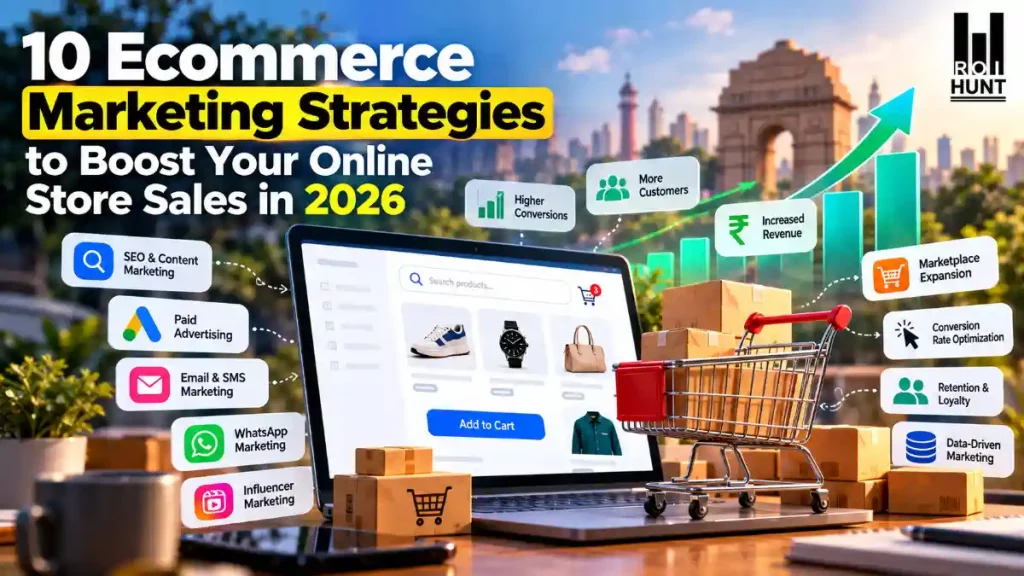
This guide covers the ecommerce marketing strategies that drive profitable sales in 2026, and more importantly, how to decide which one to work on first. For each strategy, you’ll see when to prioritize it, how to implement it, what to measure and the mistake to avoid. After that, there’s a budget framework, the KPIs that show if you’re actually making money, and a 30-day action plan you can start this week.
It’s written for store owners, D2C founders and ecommerce marketing managers who need to grow sales without burning cash.
What Is Ecommerce Marketing?
Ecommerce marketing is the process of attracting shoppers to an online store, converting them into customers and bringing them back to buy again. It uses digital marketing channels such as search engine optimization, paid advertising, email, SMS, social media and content, supported by analytics and conversion optimization.
You’ll also see it written as e-commerce marketing. The discipline is the same.
Every ecommerce marketing activity does one of three jobs:
- Acquisition: finding potential customers and winning the first order.
- Conversion: turning visits into orders.
- Retention: getting the second, third and tenth order from people who already bought.
Most marketing spend goes into acquisition. Retention is where many stores find their margin, because you don’t pay for another ad click to reach someone already on your email list.
Marketing for ecommerce differs from general digital marketing in three practical ways. You can tie most activity to an order, so revenue and profit can be measured closely. Your product economics (margins, order value, shipping and returns) decide what you can afford to pay for a new customer. And much of the work happens on your own catalog: product pages, category pages and product feeds.
Strategy vs tactics: a strategy is a decision about where to focus, such as “increase repeat purchases from first-time buyers.” Ecommerce marketing tactics are the actions that carry it out: a reorder email at day 25, a loyalty tier, a bundle offer. Many underperforming stores have plenty of tactics and no strategy connecting them.
How to Choose the Right E-commerce Marketing Strategies for Your Store
Choose based on your biggest constraint, not on what’s popular. If you lack traffic, focus on acquisition. If you have traffic but few sales, fix conversion. If customers buy once and disappear, build retention. Then check your margins, average order value and available time before committing budget to any channel.
Effective ecommerce marketing comes down to sequencing, and no two stores need the same mix of ecommerce strategies. Five factors should shape your choice:
- Business stage. A new ecommerce business needs demand signals and early customers. An established store usually needs better efficiency and more repeat business.
- Margins and average order value. High margins can absorb paid acquisition costs. Thin margins and low order values need repeat purchases or bigger baskets before ads become profitable.
- Purchase frequency. Consumables such as coffee, skincare and pet food reward retention work. One-time purchases such as furniture lean more on acquisition, content and referrals.
- Resources. SEO and content need patience and writing capacity. Paid ads need cash and creative. Email needs a list and a few days of setup.
- Customer behavior. Where do your buyers research? Google, Instagram Reels, marketplaces and WhatsApp groups each point to different channels and strategies.
Use this matrix as a starting point:
| Your situation | Main constraint | Start with | Hold off on |
| New store, little traffic, small budget | No demand or data yet | Product page quality, small paid tests on one or two hero products, email capture, SEO foundations | Scaling ad spend, large influencer deals |
| Steady traffic, low conversion rate | Conversion | CRO, mobile checkout, product page content | Buying more traffic |
| Good first orders, few repeat buyers | Retention | Email and SMS flows, replenishment reminders, loyalty | Deeper acquisition discounts |
| Rising CAC on paid channels | Acquisition cost | Creative testing, SEO and content, retention to lift lifetime value, marketplaces | Raising bids or budgets to hold volume |
| Low AOV, thin margins | Unit economics | Bundles, free-shipping thresholds, upsells | Sitewide discounts, free shipping on every order |
| Established brand, growth has plateaued. | Reach | Marketplaces, affiliates, new content clusters, omnichannel | Rebuilding channels that already work |
10 Ecommerce Marketing Strategies That Drive Growth in 2026
The ten strategies below follow the order in which a shopper experiences them: getting found, deciding, buying and coming back. You won’t need all ten at once. Tie each one to one of your marketing goals, pick two or three that match your constraint, do them well, then add more.
1. Search Engine Optimization (SEO) and Product Page Optimization
Search engine optimization brings in shoppers who are already looking for what you sell. For an ecommerce site, the pages that matter most are usually category pages and product pages, not blog posts. SEO solves the problem of paying for every visit. Once a page ranks, it can keep bringing traffic without a cost per click, though it needs ongoing work to hold its position.
Prioritize it when: people actively search for your products, paid clicks in your category are expensive, and you can wait several months for results.
How to implement it:
- Map keywords to page types. Category pages target broad terms (“men’s running shoes”). Product pages target specific model and attribute terms. Guides target questions (“how to choose running shoes for flat feet”).
- Fix the product page basics. Write unique descriptions instead of copying the manufacturer’s text, and include clear titles, specifications, sizing, delivery and return information, and genuine reviews.
- Add product structured data and a product feed. Product schema helps Google show price, availability and ratings in results. A feed in Google Merchant Center also makes products eligible for free listings on Google’s Shopping tab.
- Clean up store-specific technical issues. Filter and sort URLs can create thousands of duplicate pages. Decide how to handle out-of-stock products, compress images, and link from categories to products.
- Refresh your top pages. Use the Queries report in Google Search Console to see what people searched before landing on each page, then update the content to match.
AI Overviews and AI assistants now answer many product research questions. Google’s own guidance says there are no extra technical requirements to appear in its AI features beyond normal Search eligibility, so the same work applies: crawlable pages, clear and specific answers, accurate product data and genuine reviews.
Useful tools: Google Search Console, Google Merchant Center, and Semrush or Ahrefs for keyword gaps.
Track: organic revenue from non-branded searches (primary); impressions and clicks for target queries, organic conversion rate and indexed product pages (supporting).
Common mistake: publishing blog posts while category and product pages stay thin. A buying guide can’t rescue a product page with 40 words of copied manufacturer text.
Example (hypothetical): A running shoe store sees the query “running shoes under 5000” getting impressions at position 15 for its men’s category page. A price-filtered subcategory with its own heading, short intro and internal links is a more direct fix than another blog post.
2. Paid Advertising and Shopping Campaigns
Paid advertising buys visibility immediately. It solves the speed problem: you can put a new product in front of potential customers today instead of waiting months for SEO. The trade-off is that traffic stops when spending stops, and costs tend to rise as more brands compete for the same audiences.
Prioritize it when: you’re launching, testing demand for a new product, need data quickly, or have margins that can support the cost of acquiring a customer.
How to implement it:
- Calculate break-even ROAS before launching. Break-even ROAS = 1 ÷ contribution margin (as a decimal). At a 40% contribution margin, break-even ROAS is 2.5. Below that, you lose money on the first order.
- Start with high-intent placements. Google Shopping and Performance Max campaigns reach people searching for products. Branded search protects your name from competitors.
- Use social ads for discovery. Short, UGC-style videos on Meta (Facebook and Instagram Reels) and YouTube introduce products to people who weren’t searching yet.
- Retarget carefully. Show ads to people who viewed products or added to cart but didn’t make a purchase, cap how often they see them, and exclude recent buyers.
- Test one variable at a time. Change the creative, the audience, the offer or the landing page, not all four. Set a fixed budget and a stop rule before the test starts.
- Scale in steps. Increase budgets gradually on what’s working, and refresh creative when frequency rises and click-through rate falls.
Track: cost per new customer (primary); ROAS against break-even ROAS, click-through rate, cost per click and landing page conversion rate (supporting).
Common mistake: judging every campaign on platform-reported ROAS. Retargeting and branded search often take credit for sales that would have happened anyway, so blended numbers look better than the real cost of a new customer.
Example (hypothetical): A brand sees 6x ROAS on retargeting and 1.8x on prospecting, so it pauses prospecting. A few weeks later, retargeting results drop too, because prospecting was what filled the retargeting audience.
3. Ecommerce Content Marketing Strategies
Ecommerce content marketing means creating content that helps shoppers choose, use and trust your products: buying guides, comparisons, how-to videos, size help, care instructions and real customer stories. It solves two problems. It brings search traffic for questions your product pages can’t rank for, and it answers the doubts that stop people from buying.
A content marketing strategy for ecommerce works differently from a publisher’s strategy. The goal isn’t page views. It’s helping a shopper move from “what should I buy?” to “this one” to “that was a good decision.”
Prioritize it when: your products need explanation, purchases are considered rather than impulsive, paid traffic is getting expensive, or category pages struggle to rank for broader terms.
Match Content to the Purchase Stage
Good content marketing strategies for ecommerce start from what shoppers ask, not from what the brand wants to say.
| Purchase stage | What the shopper is asking | Content that answers it | Where it lives |
| Problem awareness | “Why does my skin feel tight after washing?” | Educational guides, short explainer videos | Blog, YouTube, Instagram |
| Comparison | “Cotton or linen bedsheets for summer?” | Buying guides, honest comparisons, “best X for Y” pages | Blog, category pages |
| Decision | “Will this fit? Will it work for me?” | Size guides, product demo videos, customer photos, product FAQs | Product pages |
| After purchase | “How do I use or care for this?” | Setup guides, care instructions, recipes, routines | Email flows, help pages, QR code on packaging |
| Advocacy | “What do other buyers think?” | Review requests, featured customer photos | Product pages, social media |
Content Formats That Support Sales
- Product-led content: topics where your product is the natural answer, such as “how to style a linen kurta for the office.” It should still help a reader who doesn’t buy.
- Buying guides and comparisons: explain how to choose, compare your own variants, and be honest about who each option suits.
- Product demos and videos: show size, texture and how the product works, on the product page as well as YouTube or Instagram.
- User-generated content: customer photos, reviews and videos, used with permission.
Plan Content Around Search Data
SEO and content marketing work best as one plan:
- Collect real questions from Search Console, site search, support tickets, reviews and the “People also ask” box.
- Group them by purchase stage and assign each topic to the product or category page it should link to.
- Prioritize topics close to something you sell over high-volume topics with no product connection.
- Write one page per search intent. Five near-identical posts compete with each other.
Distribute What You Publish
Publishing is half the job. Send new guides to the relevant email segment, cut them into Reels or Shorts, embed demo videos on product pages, and put a small paid budget behind pieces that already perform well organically. For home decor and fashion, Pinterest is worth testing too.
Track: revenue from sessions that included a content page, using GA4’s conversion paths (primary); organic clicks for the target query group, click-through from content to product pages, and email signups from content (supporting). Content can drive traffic for months after publishing, so review it over a longer window than ads.
Common mistake: publishing generic topics with no link to anything you sell, such as a skincare store writing about the history of soap. Visitors arrive and leave.
Example (hypothetical): A bedsheet brand keeps getting support questions about thread count. One clear guide on what thread count does and doesn’t tell you, linked to the three relevant collections and added to the post-purchase email, answers the question once for search, for pre-sale doubts and for support.
4. Email Marketing and Ecommerce Marketing Automation
Email marketing is a channel you own. No algorithm decides whether subscribers see your message, and the cost of each send is low. Ecommerce marketing automation sends the right message based on what a person did or didn’t do: signing up, browsing, leaving a cart, buying or going quiet. It fixes the leak where interested shoppers and past buyers drift away without hearing from you.
Prioritize it when: almost always, and early. It’s especially urgent if you have traffic but no list, or customers but few repeat orders.
| Flow | Trigger | Purpose |
| Welcome series | Email signup | Introduce the brand and earn the first order |
| Browse abandonment | Viewed a product, didn’t add to cart | Remind and answer common objections |
| Abandoned cart | Added to cart, didn’t check out | Recover the order, address shipping and trust concerns |
| Post-purchase | Order shipped or delivered | Set expectations, explain use, request a review |
| Replenishment and cross-sell | Your typical reorder time | Win the next order |
| Win-back | No purchase within your normal buying cycle | Re-engage before the customer is lost |
| VIP | Top spenders or most frequent buyers | Reward and retain your best customers |
How to implement it:
- Add signup options where intent is high, such as product pages and checkout (with clear consent), not just the footer.
- Build the flows above before investing in more newsletters. They run every day without extra work.
- Segment campaigns by purchase history (never bought, bought once, repeat, VIP) and by product interest.
- Design for phones: short subject lines, one main call to action, large buttons.
- Follow deliverability best practices. Gmail and Yahoo have required bulk senders to authenticate their domains and offer easy unsubscribes since 2024. Remove subscribers who haven’t engaged for a long time.
Useful tools: Klaviyo, Omnisend and Mailchimp all integrate with Shopify and WooCommerce. Choose based on your store platform, list size and if you also need SMS.
Track: revenue per recipient for flows and campaigns (primary); click rate, placed-order rate, unsubscribe rate, spam complaint rate and list growth (supporting). Treat open rates as a rough signal, because Apple Mail Privacy Protection pre-loads emails and inflates opens.
Common mistake: putting a discount in every email. Shoppers learn to wait for the code, and people who would have paid full price stop doing so.
Example (hypothetical): A store sends only a weekly newsletter. After adding welcome, abandoned cart and post-purchase flows, it compares revenue per recipient for flows and newsletters after 30 days to decide where the next hour of work should go.
If you’d prefer to have this built and managed for you, ROI Hunt’s email marketing services cover flow setup, segmentation and campaign management.
5. Mobile Marketing for Ecommerce
Mobile marketing for ecommerce covers two things: reaching shoppers on their phones (SMS, WhatsApp, push notifications, mobile-friendly email and social ads) and making sure the experience they land on works on a small screen. For many stores, most online shopping sessions start on a phone. Check the device report in GA4 for your own share rather than relying on industry averages, because it varies widely by category and audience.
Speed is a large part of the mobile experience. In a Google-commissioned study by Deloitte, based on 2019 data from 37 brand sites, a 0.1-second improvement in mobile site speed was associated with an 8.4% increase in retail conversions. Your numbers will differ, but the direction is clear: friction on mobile costs sales.
Prioritize it when: most of your traffic is mobile, your mobile conversion rate trails desktop, or your audience responds to messaging apps more than email.
How to implement it:
- Audit the mobile product page. Price, variant selector, delivery estimate and the add-to-cart button should be visible without long scrolling. Images should zoom, and reviews should be easy to reach.
- Simplify mobile checkout. Offer guest checkout, address autofill and the payment methods your buyers use, such as UPI and cash on delivery in India or Apple Pay, Google Pay and Shop Pay elsewhere. Remove form fields you don’t need.
- Check mobile Core Web Vitals. Use the Core Web Vitals report in Search Console. Compress images and remove apps and scripts that slow pages down.
- Use SMS marketing and WhatsApp with clear opt-in. Rules vary by country. In India, commercial SMS must go through TRAI’s DLT system with registered templates. In the US, marketing texts require prior express written consent under the TCPA. Use these channels for time-sensitive messages: back-in-stock alerts, delivery updates, cart reminders and early access for VIPs.
- Build mobile-first acquisition creative. Use vertical video for Reels, Shorts and Stories, add captions for sound-off viewing, and send traffic to a landing page that matches the ad.
- Measure by device. Compare conversion rate and checkout drop-off on mobile vs desktop.
A typical customer journey crosses devices. Someone may find you through a Reel, compare options on a laptop, and buy after an SMS reminder. Device reports show where mobile visitors drop out of that journey.
Track: mobile conversion rate (primary); the gap between mobile and desktop conversion rates, mobile checkout completion, mobile page speed, and SMS click and opt-out rates (supporting).
Common mistake: designing and approving pages on a desktop monitor. Review every key page on a mid-range phone using mobile data.
Example (hypothetical): 75% of a store’s sessions are on mobile, but mobile converts at half the desktop rate. Before launching any new campaign, the mobile product page and checkout are the biggest levers available.
6. Social Media Marketing, Influencer Marketing and UGC
Social media marketing gets products discovered by people who weren’t searching for them yet. Influencer marketing and user-generated content (UGC) add something ads struggle to provide: proof from real people. Together, they close the trust gap for new or unfamiliar brands and help drive online sales from shoppers who would never have searched for you.
Prioritize it when: your products are visual or easy to demonstrate, your brand is new, or search-based acquisition is getting expensive.
How to implement it:
- Pick one or two social media platforms where your buyers already spend time. Instagram suits fashion and beauty, YouTube suits products that need demos, and Pinterest suits home decor. Two platforms done well beat five done badly.
- Show the product in use. Short native video usually tells shoppers more than polished product shots.
- Work with creators whose audience matches your buyer. Give a clear brief (key message, claims to avoid), let them speak in their own voice, and ask for usage rights so you can reuse the content in ads. Paid partnerships must be disclosed under ASCI guidelines in India and FTC rules in the US.
- Collect UGC systematically. Ask for photos in post-purchase emails and use a review tool that accepts photo uploads. Don’t pay for positive reviews.
- Put UGC where decisions happen: product pages, ads and email.
Track: sales per creator or post through unique codes or UTM links (primary); cost per acquired customer per creator, engagement rate and performance of creator content reused in ads (supporting).
Common mistake: choosing creators on follower count alone. A creator with a smaller audience in your exact category can sell more than a general lifestyle account.
Example (hypothetical): A brand gives ten creators unique discount codes. Two drive most of the orders. The brand turns their videos into ads, extends those two partnerships and doesn’t renew the rest.
7. Conversion Rate Optimization (CRO): Remove What Stops a Shopper From Buying
Conversion rate optimization means finding and removing the reasons visitors don’t buy. It solves the most expensive problem in ecommerce: paying for traffic that leaves. When your ecommerce website converts better, every other channel becomes more efficient, because each visitor is worth more. More website traffic won’t fix a store that doesn’t convert. It just makes the leak bigger.
Baymard Institute’s running average of 50 studies puts documented cart abandonment at about 70%. In its checkout research, unexpected extra costs (shipping, taxes and fees) are the most common reason given by shoppers who weren’t just browsing, followed by slow delivery, distrust of the site with payment details and forced account creation.
Prioritize it when: you have enough traffic to measure changes and your conversion rate trails your own past performance. Fix conversion before scaling ad spend.
How to implement it:
- Map the funnel in GA4. Product view → add to cart → begin checkout → purchase, split by device. Find the biggest drop.
- Watch real sessions. Tools such as Microsoft Clarity and Hotjar show heatmaps and recordings of where shoppers hesitate. Optimize the highest-traffic pages first.
- Fix obvious friction without waiting for a test. Show shipping costs and delivery dates on the product page, enable guest checkout, remove unnecessary form fields, offer trusted payment methods and make the return policy easy to find.
- Strengthen product pages. Use clear photos and video, specifications, size guidance, reviews near the add-to-cart button and accurate stock information. Use urgency only when it’s true. Fake scarcity damages trust, and India’s 2023 dark patterns guidelines specifically cover false urgency.
- A/B test bigger changes when you have enough traffic for a reliable result. With low traffic, compare equal periods before and after a change and treat the result as directional.
Track: conversion rate (orders ÷ sessions) by device and traffic source (primary); add-to-cart rate, checkout completion rate, average order value and revenue per session (supporting).
Common mistake: running A/B tests on low-traffic pages and declaring a winner after a few days. Small samples produce random “wins.”
Example (hypothetical): A home decor store gets 40,000 sessions a month and converts at 0.6%, which is 240 orders. Add-to-cart rates look healthy, but there’s a sharp drop at checkout, where shipping charges first appear. The first fixes are showing shipping costs on the product page and setting a free-shipping threshold slightly above the current average order value. If conversion moves from 0.6% to 0.9%, that’s 360 orders from the same traffic, or 120 extra orders without extra ad spend. Only the next month’s data will show whether it gets there.
ROI Hunt’s conversion rate optimization services follow the same diagnose, fix and test process for ecommerce stores.
8. Personalization, Customer Loyalty and Retention
Retention marketing turns first-time buyers into repeat customers. Personalization makes your store and messages relevant to each shopper based on what they viewed or bought. Loyalty programs give people a reason to come back to you instead of a competitor. Together, they raise customer lifetime value, which is what lets you afford to acquire customers in the first place.
If you’re looking for strategies to boost profit without increasing ad spend, start here.
Prioritize it when: your products can be bought more than once but repeat purchase rate is low, acquisition costs are rising, or you have enough customers to segment meaningfully.
How to implement it:
- Find your buying cycle. Calculate the median number of days between a customer’s first and second order, and time reminders around it.
- Personalize what people see, not just their name. Show recently viewed items, related products, “complete the set” bundles and one-click reorder options. Use purchase history to decide which products appear in each email.
- Raise average order value without blanket discounts. Bundles, volume pricing and free-shipping thresholds protect margin better than sitewide sales.
- Pick a loyalty structure that fits. Points suit frequent, low-cost purchases. Tiers suit high-value customers. Referral rewards suit products people talk about. Keep the rules simple enough to explain in one sentence, because customer loyalty programs that need a manual rarely get used.
- Treat the post-purchase experience as marketing. Packaging, delivery updates, how-to content and easy returns all influence whether someone buys again.
Track: repeat purchase rate within a window that fits your buying cycle, such as 90 or 180 days (primary); customer lifetime value, time to second order, average order value and loyalty members’ share of revenue (supporting).
Common mistake: treating personalization as adding a first name to subject lines. Useful personalization changes what people see, when they see it and what they’re offered.
Example (hypothetical): A coffee brand acquires customers efficiently through ads, but only 12% order again within 90 days. Most bags last about four weeks. A reorder reminder at day 21 with a one-click link, a brewing guide in the post-purchase flow and a subscribe-and-save option address the gap. The metric to watch is the 90-day repeat purchase rate, not the revenue from any single email.
9. Affiliate Marketing, Marketplaces and Omnichannel Marketing
Some shoppers will never start on your own website. Affiliate marketing pays partners such as content sites, coupon sites and creators a commission on the sales they refer. Marketplaces like Amazon and Flipkart put your products where many online shoppers already begin their search. Omnichannel marketing connects these channels, plus physical retail if you have it, so customers get consistent products, prices and service wherever they buy.
These are strategies to drive reach beyond your own site, and they work best once that site converts well.
Prioritize it when: your product has proven demand, your category is active on marketplaces, you want reach without paying for media upfront, or direct-to-consumer growth has plateaued.
How to implement it:
- Set affiliate commissions from your contribution margin, not from what competitors pay. Limit coupon and cashback partners that mostly reach customers who were already checking out.
- Decide what to sell where. Some brands list bestsellers on marketplaces and keep bundles or the full range on their own site. Keep pricing consistent to avoid channel conflict.
- Count every marketplace cost. Referral fees, fulfilment fees, returns and marketplace ads all come out of margin.
- Connect the experience. Keep product information, pricing and customer service consistent across your site, marketplaces, WhatsApp and stores.
Track: contribution margin by channel (primary); new customers from affiliates, marketplace ACoS (ad spend ÷ ad-attributed sales) and TACoS (ad spend ÷ total sales), and each channel’s share of revenue (supporting).
Common mistake: treating marketplace revenue as pure upside. After fees and advertising, some products lose money on every marketplace order.
Example (hypothetical): A kitchenware brand’s cheapest item sells well on a marketplace but barely breaks even after fees and ads. The brand keeps the listing only because those buyers later come to its own site for higher-margin products, and it checks that assumption each quarter against actual repeat data.
10. Analytics and Attribution: Measuring Profit Across Every Platform
Every strategy above depends on knowing what’s working. Analytics shows what happened. Attribution decides which channel gets credit. Profitability measurement tells you whether you made money. Without all three, an online business ends up moving budget toward whichever platform reports the biggest numbers.
Prioritize it when: always, but especially before you increase spend or add a new channel.
How to implement it:
- Make your store’s order data the source of truth. Check that GA4 purchases roughly match the orders in your ecommerce platform, and investigate large gaps.
- Tag every link you control with consistent UTM parameters before each marketing campaign goes live: email, SMS, social posts, creators and affiliates.
- Expect double counting. Google Ads, Meta and your email tool can each claim the same order.
- Track blended numbers. Marketing efficiency ratio (MER) is total revenue ÷ total marketing spend. Blended CAC is total acquisition spend ÷ new customers.
- Test incrementality when budgets are large. Pause a channel for a holdout group or region and compare results.
Useful tools: GA4, your store’s built-in analytics, Looker Studio for dashboards, and tools such as Triple Whale or Metorik for combining ad and order data.
Track: contribution profit after marketing spend (primary); MER, blended CAC and revenue from new vs returning customers (supporting).
Common mistake: adding up each platform’s reported revenue and assuming that’s what marketing produced.
Example (hypothetical): In one month, Meta reports ₹4 lakh in sales, Google reports ₹3 lakh and email reports ₹2 lakh. The store’s actual revenue was ₹6 lakh, so at least ₹3 lakh of the reported revenue is double-counted.
How to Build an Ecommerce Marketing Plan on a Limited Budget
Start by working out how much you can afford to pay for a customer. Then spend first on fixes that make every visitor more valuable, such as product pages, checkout and email flows. Use what’s left for one acquisition test at a time, with a fixed budget, a time limit and a decision rule agreed before launch.
Step 1: Work Out What You Can Pay for a New Customer
- Contribution per order = average order value − product cost − shipping − payment fees − average cost of returns and discounts.
- Break-even CAC on the first order = contribution per order.
- If customers reliably reorder, you can pay more than first-order break-even, but only if your cash flow can wait for the later orders.
Step 2: Optimize Your Ecommerce Website Before You Scale
Product page improvements, checkout fixes and email flows cost little and raise the value of every future visitor. Doing them first is often one of the best ways to make later ad spend work harder.
Step 3: Test Marketing Tactics One at a Time
Write down five things before each test: the hypothesis, the budget, the duration, the success metric and the stop rule. Change one variable at a time. A good weekend is not a trend.
Step 4: Split the Budget Across Marketing Channels (Worked Example)
Hypothetical store: a new skincare brand with a ₹60,000 monthly marketing budget, about 3,000 sessions a month, 400 email subscribers, an average order value of ₹900 and a contribution of about ₹450 per order. Its break-even CAC on the first order is roughly ₹450. The owner is deciding between SEO, paid ads and email marketing.
| Area | Share of this budget | Why |
| Email and SMS setup (tools, welcome and cart flows) | About 10% | Low cost, recovers revenue from existing traffic |
| Paid test on two hero products | About 50% | Fastest way to learn whether the offer works and what a customer costs |
| SEO and content (category pages, two buying guides) | About 25% | Slow to pay back, but builds traffic the store won’t pay for per click |
| Creator seeding for UGC | About 15% | Creates proof for product pages and ad creative |
This is one reasonable split for this specific store, not a benchmark. Putting everything into ads would amplify an unproven product page. Putting everything into SEO would leave the store waiting months for cash flow. The decision rule: if the paid test’s cost per new customer stays below ₹450 over four weeks with enough orders to judge, shift more budget there. If it’s well above, pause and fix the product page or offer first.
How Margins, Order Value and Cash Flow Shape Your Ecommerce Strategies
- Low AOV: paid acquisition rarely works until bundles or repeat purchases raise the value of each customer.
- High margins: you can afford a higher CAC and scale paid channels sooner.
- Tight cash flow: favor channels that pay back quickly, such as email to existing customers.
- Seasonal demand: plan marketing spend around demand peaks instead of spreading it evenly.
How to Measure Ecommerce Marketing Success: KPIs to Track
The core ecommerce marketing KPIs are customer acquisition cost (CAC), return on ad spend (ROAS), conversion rate, average order value (AOV), customer lifetime value (CLV), repeat purchase rate and contribution margin. Revenue and ROAS show activity. Contribution margin after marketing shows whether that activity made money.
| KPI | How to calculate it | What it tells you | Watch out for |
| Customer acquisition cost (CAC) | Acquisition spend ÷ new customers | What it costs to win one new customer | Include creator and agency fees; separate new and returning customers |
| Return on ad spend (ROAS) | Ad-attributed revenue ÷ ad spend | Revenue efficiency of ads | It’s revenue, not profit, and usually platform-reported |
| Conversion rate | Orders ÷ sessions | How well the store turns visits into orders | Varies by device, source and category; compare against your own baseline |
| Average order value (AOV) | Revenue ÷ orders | Typical basket size | Discount-led bundles can raise AOV while lowering margin |
| Customer lifetime value (CLV or LTV) | Contribution per order × expected orders per customer in a set period | What a customer is worth over time | Use contribution, not revenue, and a fixed window such as 12 months |
| Repeat purchase rate | Customers with 2+ orders ÷ all customers in the period | Retention health | Depends on how often the product is naturally bought |
| Contribution margin | Revenue − variable costs (product, shipping, payment fees, returns, discounts) | Profit per order before fixed costs | The metric most often missing from marketing reports |
| Marketing efficiency ratio (MER) | Total revenue ÷ total marketing spend | Blended efficiency across channels | Still revenue-based |
| Email and SMS performance | Revenue per recipient, click rate, unsubscribe and complaint rates | Health of owned channels | Open rates are inflated by privacy features |
Before each month starts, define what ecommerce marketing success means for your store: a contribution target, not just a revenue target.
Why Discounts Can Boost Sales and Still Cut Profit
Discounts boost sales, but they also change the economics of every order. Here’s a simplified, hypothetical example of a store running a 25% sitewide sale:
| Metric | Normal month | Sale month (25% off) |
| Orders | 400 | 640 |
| Average order value | ₹1,500 | ₹1,125 |
| Revenue | ₹6,00,000 | ₹7,20,000 |
| Ad spend | ₹1,80,000 | ₹2,40,000 |
| ROAS | 3.3 | 3.0 |
| Ad cost per order | ₹450 | ₹375 |
| Variable cost per order (product, shipping, fees) | ₹750 | ₹750 |
| Contribution before ads | ₹3,00,000 | ₹2,40,000 |
| Contribution after ads | ₹1,20,000 | ₹0 |
Revenue grew 20%. Orders grew 60%. Ad cost per order fell, and ROAS barely moved. Profit disappeared. The discount cut the contribution margin from 50% to about 33%, which raised break-even ROAS from 2.0 to 3.0, so the sale month only broke even.
Discounts can still make sense, for example to clear old stock or to acquire customers who reliably reorder. Plan for the margin impact before the campaign starts.
A 30-Day E-commerce Marketing Plan for Your Online Store
This plan suits a founder or a small team, and it works on one constraint at a time.
Week 1: Set Baselines and Find the Main Constraint
Deliverables:
- A tracking check: GA4 purchases compared with platform orders for the last 30 days, plus a shared UTM naming sheet.
- A baseline sheet: sessions, conversion rate by device, AOV, ad spend, CAC, ROAS, 90-day repeat purchase rate, email list size, flow revenue and contribution per order for your top 10 products.
- A funnel report by device, from product view to purchase.
- A one-line constraint statement: “Our main constraint is ___ because ___.”
Week 2: Fix the Biggest Conversion or Retention Issue
Deliverables (pick the track that matches your constraint):
- Conversion track: shipping costs and delivery dates on product pages, fewer checkout fields, guest checkout enabled, and improved copy, images and reviews on your top 10 product pages.
- Retention track: welcome, abandoned cart and post-purchase flows live, plus a replenishment reminder if your products get reordered.
Metrics: add-to-cart rate and checkout completion rate, or flow revenue per recipient, compared with your Week 1 baseline.
Week 3: Test One Paid or Content Marketing Initiative
Deliverable: a one-page test brief with hypothesis, budget, duration, success metric and stop rule. Then run one of these:
- A paid campaign on one or two hero products.
- One buying guide plus one updated category page, distributed through email and social.
- Five to ten creators with tracked codes.
Metrics: cost per new customer against break-even CAC, click-through rate and landing page conversion rate. For content, track impressions, clicks and click-through to product pages.
Week 4: Review Results and Decide What to Scale
Deliverables: a comparison of every metric against the Week 1 baseline, a decision for each change, and a plan for the next 30 days.
- Keep or scale if it beat the target with enough data to trust.
- Change if the direction is right but results are below target.
- Stop if it’s clearly below break-even after a fair test.
SEO and content rarely show full results in 30 days. Judge them on leading indicators such as indexing, impressions and early clicks.
Common Mistakes That Hurt Your Ecommerce Marketing Efforts
- Scaling ad spend before the store converts. Sending more traffic to your online store multiplies the leak if the product page and checkout aren’t working.
- Trusting platform attribution without checking. Compare platform-reported revenue with actual orders every month.
- Running weak product pages. Copied descriptions, few images and hidden delivery costs undermine all your ecommerce marketing efforts.
- Scaling too early. A strong week on a small budget doesn’t prove a campaign will hold at five times the spend. Increase budgets in steps.
- Discounting by default. Frequent sales train customers to wait and cut the margin you need for acquisition.
- Spreading effort too thin. Three channels run well usually beat eight run half-heartedly.
- Reporting vanity metrics. Followers and impressions matter less than orders, repeat purchases and contribution.
Frequently Asked Questions
For most small stores, the best starting points are strong product pages, email automation (welcome, abandoned cart and post-purchase flows), and small, controlled paid tests on one or two hero products. Start SEO and content early too, because they take months to build. Choose based on your main constraint: traffic, conversion or repeat purchases.
Make existing traffic more valuable first. Fix product pages and checkout friction, set up automated email flows, and add bundles or free-shipping thresholds to lift order value. Then run one small, measured acquisition test at a time. These steps can boost online sales without a large increase in marketing spend, though results depend on your products and audience.
A good content marketing strategy answers the questions shoppers ask at each stage of buying, links every piece to a relevant product or category page, and is distributed through email and social media as well as search. Buying guides, comparisons, demo videos and customer content usually drive sales most directly.
Ecommerce marketing automation sends messages triggered by customer behavior, such as signing up, abandoning a cart, buying or going inactive. Common examples are welcome series, abandoned cart reminders, post-purchase emails, replenishment reminders and win-back campaigns. Marketing tools such as Klaviyo, Omnisend and Mailchimp run these flows across email and SMS.
It usually takes months rather than weeks. Timelines depend on your site’s authority, competition, technical health and how much content needs fixing. Product and category pages that already get impressions in Search Console are often the quickest wins, because Google already considers them relevant.
Review tactics weekly, budgets and channel performance monthly, and the overall strategy quarterly. Review sooner if costs jump, conversion drops or a major platform change affects your traffic.
Final Thoughts: Grow Your Business With Successful Ecommerce Marketing
Successful ecommerce marketing is rarely about finding one perfect channel. It comes from a few clear decisions: identify what’s limiting growth, know what a customer is worth to you, fix conversion and retention before buying more traffic, and measure profit, not just revenue. Effective marketing compounds when each step makes the next one cheaper.
Start with Week 1 of the action plan. A clear baseline will tell you more about what to do next than any list of tactics.
If you’d like help putting this into practice, ROI Hunt works with D2C brands and online business owners on SEO, paid media, email, CRO and retention. Our ecommerce marketing services start with an audit of where your store is losing money, so the plan to grow your business and online presence is built on your own numbers.