
Top 10 Benefits of Performance Marketing
Performance marketing is basically performance based digital marketing. A result driven marketing where you only pay when a specific action is completed. So you only pay once the desired action is completed i.e. a sale or a subscription signup. Let’s see why performance marketing is so beneficial for small as well as large businesses.
Before getting into the benefits of performance marketing, let’s take a look at how it is different from traditional marketing.
It is different from traditional marketing in the sense that it allows you to only pay for results, whereas in traditional marketing that’s not the case. In traditional marketing, we put in the money and hope for the best. Performance marketing is different and much more likely to give measurable and profitable outcomes.
Traditional vs Performance Marketing
| Traditional Marketing | Performance Marketing | |
| Objective | You pay for exposure and brand awareness. | You pay only for results. |
| Target | Broad and non-specific audience. | Highly targeted audience based on interests. |
| Examples | TV, magazines, live events, billboards. | Email marketing, social media, search ads. |
| Cost | Fixed and often expensive with unclear ROI. | Flexible and cost-effective. |
| Performance Indicators | ROI is difficult to measure. | ROI measured via leads, sales, conversions. |
| Time Frame | Best for long-term brand building. | Focused on short-term profit and growth. |
Benefits of Performance Marketing
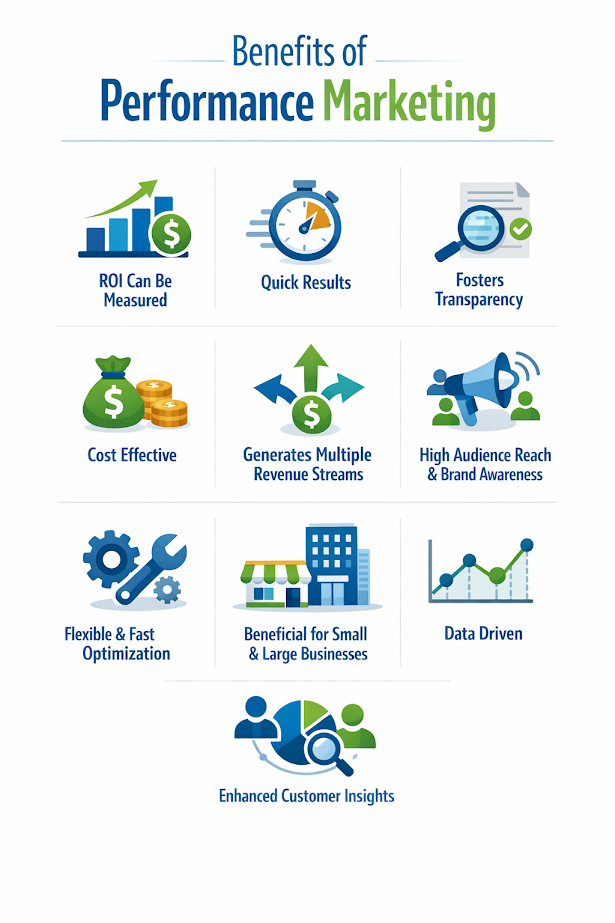
1. ROI can be Measured
Unlike traditional advertising, the results you want can be tracked and measured through clicks, sales or leads in performance marketing. So if you are not getting the desired results from a specific channel/advertisement method, you can either change the strategy or invest in some other channels. You can try email marketing, social media marketing, mobile marketing etc and if you go further, you can optimise each of the channels. This gives a lot of scope for optimization and profit.
2. Quick Results
If compared with brand marketing and traditional marketing, performance marketing focuses on the short term goal of driving profits. Hence, it is quick, trackable, and focused on generating results.
3. Fosters Transparency
Performance marketing is highly transparent for the advertisers. Agencies or publishers are paid only when they get results. So, it becomes the agency’s responsibility to put in the effort and bring results. The KPIs can be measured and checked by both parties and discussed, and changes can be made according to that.
4. Cost-Effective
Because performance marketing strategies only work to pay for desired action, it becomes really cost effective for the advertiser; they only have to pay for the action they wanted the customer to take. In case it is not happening, they can shift the funding to another channel that is giving results.
5. Generates Multiple Revenue Streams
In performance marketing, you can invest in different marketing channels, creating different revenue streams for your business. With the help of performance marketing, you can collect data on different channels. These insights can help make better decisions and slowly optimize different channels that help you expand the revenue streams. You don’t have to rely on one source and you shouldn’t be. You can try email marketing, SMM, search engine marketing, native advertising, and mobile advertising. There are so many options through which you can generate revenue.
6. High Audience Reach and Brand Awareness
It not only drives conversions but also helps reach a wider audience. Performance marketing can tap a highly targeted audience for your business and can help grow your reach. It also complements brand marketing, as it is a small part of the brand awareness strategy, which is a long term strategy. Basically, it helps you reach targeted audiences who might be interested in the products while at the same time driving conversions from existing customers.
7. Flexible and Fast Optimisation
Performance marketing strategies can be quickly optimized and are pretty flexible. If a campaign is not performing, you can make changes without wasting any time or money. You can either pull out the funds or invest more depending on the campaign performance, which is tracked in real time. This makes it highly flexible and the best part is you are making changes not based on opinions or assumptions but real time data.
8. Beneficial for Both Small and Large Businesses
Performance marketing is beneficial for both small and big companies. For small companies it is a cost effective way to drive revenue. They can also experiment with different channels, get insights and use the data to further optimize things. On the other hand, for big companies, they can improve and work on a specific demographic they haven’t tapped into. It also makes sure the campaign fund is showing the results it is supposed to.
9. Data Driven
Performance marketing is all about data and insights. If used correctly, it can give you so much data about your target audience. With the right datasets, you don’t have to rely on or take decisions based on someone’s opinions, you take smart decisions based on the data you receive. Having this data helps improve the campaigns and ultimately results in profits.
10. Enhanced Customer Insights
The data collected gives valuable insights, and the advanced methods used for data collection help agencies make informed decisions and smart strategies. These models help them analyse the full customer journey and create and adjust the campaign accordingly.
Conclusion
If you are not leveraging performance marketing for your business, you are missing out on a lot of potential customers. Performance marketing helps you explore different channels of marketing as well as different advertising methods like WhatsApp marketing, paid ads, etc. It gives you insights into where your target audience is and their preferences and helps you scale your business. There are so many agencies in the market providing performance marketing services that can help you reach your desired goals.