
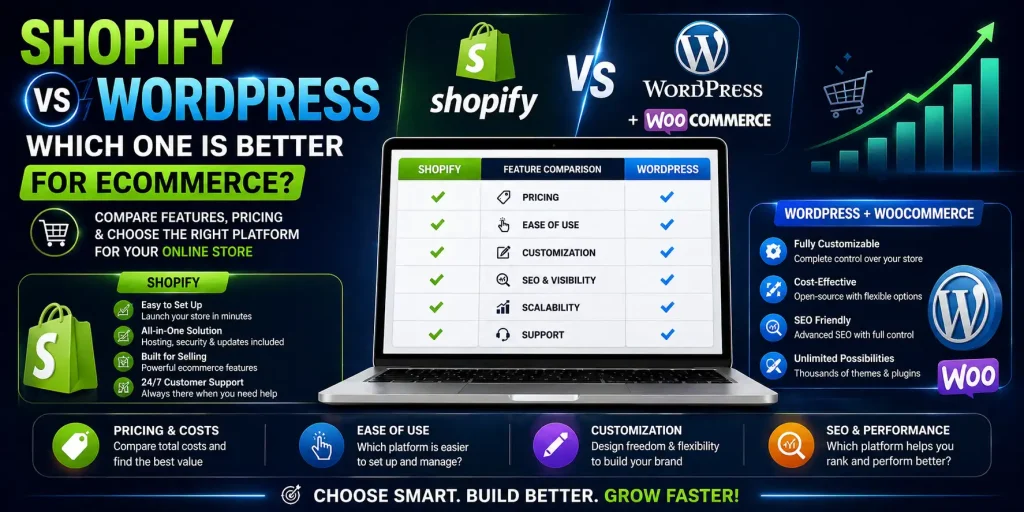
Shopify vs WordPress - Which one is Better
Looking to build an online e-commerce store? It can be really confusing, as there are many e-commerce platforms to choose from. There are different platforms available these days, some have steep learning curves, some don’t and are beginner friendly. Among all, Shopify and WordPress are two well-known platforms that are used worldwide by millions of businesses. Where, on one hand, Shopify is preferred for its ease of use by a lot of beginners, while WordPress requires a lot of technical skills and is really flexible when it comes to customization.
Today we’re going to compare these two so you can decide which one you should choose.
Shopify vs. WordPress
Pricing
The first thing we are going to compare is the price point of both.
Shopify- it has a monthly subscription fee with a basic plan starting around Rs 1400/month if you pay on a yearly basis.
- Basic Plan – INR 1994/month
- Grow Plan – INR 7447/month
- Advanced – INR 30164/month
- Shopify Plus – INR 175000/month
- There’s an additional transaction fee that can go upto 2%
Businesses planning to scale their online store often choose Shopify Plus development services to unlock advanced features and better performance.
WordPress – it is a free platform but requires paid hosting, plugins, etc. WordPress is still considered cheaper. These are some of the costs for a basic WordPress site—
Domain name – INR 800-1200
Web hosting – INR 500-1000
Premium Themes – INR 4000 – 8000
Plugins – INR 1500-2000
Developer Cost – if you do not have technical expertise, you may need to hire a developer.
Then there are backups and security tools. All in all, at first glance, WordPress’s cost might look low; it is somewhat similar to Shopify’s cost.
Design and Customization
Shopify – Shopify’s design is perfect for noobs, as these are all pre-designed. All you have to do is change the content, images, colors, fonts, etc., but if you want to modify the core design, it can be a little hard to do as it requires in-depth knowledge of coding.
Ease of Use
Technical Requirements
WordPress—for WordPress, you do need moderate level skills to set up a WooCommerce store, as the setup time and web hosting can take days if you are new, its maintenance is also manual and the various plugins have a learning curve as well. You’ll need to figure out everything on your own, such as hosting, installing WordPress, and configuring databases. Then there are themes and installing WooCommerce and setting up the shipping. Although you will find a lot of tutorials and forums online, you still won’t be able to set it up within a day unless you have the required technical knowledge for it.
Search Engine Visibility
WordPress – WordPress wins this round. Its SEO plugins and clean URL structures offer you more control over technical SEO; it is one of the most SEO-friendly platforms. Although it requires more effort, you can use advanced SEO strategies for content marketing. It also allows deeper technical optimization, such as customizing robots.txt, advanced caching strategies etc.
Customer Support
WordPress – For WordPress, you cannot contact one person for all of your issues because it is self hosted and your web hosting is from a different host provider and plugins are from different creators; you will need to contact them individually. But WordPress does have different forums for support.
Features
- Shopify
Shopify features are hassle free and ideal for beginners; their built in hosting, secure payments and easy store setup, its customizable themes, app integration and inventory management are easy to use.
- WordPress
WordPress, on the other hand, is a great option for you if you want to design your own website and want full control and are comfortable handling its technical aspects.
Here’s a comparison table of shopify features vs wordpress -
| Category | Feature | Shopify | WordPress (WooCommerce) | Winner |
|---|---|---|---|---|
| E-commerce | Built-in checkout | Native, optimised | Via WooCommerce | Shopify |
| Abandoned cart recovery | Built-in (all plans) | Plugin required | Shopify | |
| Product variants | Up to 100 per product | Unlimited | WordPress | |
| Subscription products | Via app (extra cost) | Via plugin | Tie | |
| Digital downloads | Built-in | Free plugin available | Tie | |
| Multi-currency | Built-in (Shopify Payments) | Plugin required | Shopify | |
| Inventory management | Built-in, multi-location | Basic, plugins for more | Shopify | |
| POS (Point of Sale) | Native Shopify POS | Third-party only | Shopify | |
| Gift cards | Built-in | Plugin required | Shopify | |
| Discount / coupons | Built-in, flexible | Built-in WooCommerce | Tie |
Conclusion
Shopify is the better product for selling. WordPress is the better platform for growing. If your business grows primarily through paid ads, word of mouth, or offline channels, Shopify is the smarter, simpler choice. If your business grows through Google search, content marketing, or organic traffic, WordPress is better.
But as a performance marketing company, when it comes to building and managing high-converting e-commerce stores, we’ve seen fewer technical issues and maintenance challenges with Shopify stores over the years.
We prefer the Shopify platform for its ease of use, reliability, and quick setup and launch process and because we’ve seen fewer technical issues and maintenance challenges with Shopify stores.
Ready to speak with a
marketing expert?
Give us a ring
Be honest about the potential and challenges
900+ Websites Launched
$100M+ Client Revenue Generated

