
Case Study: How ROI Hunt Increased Organic Revenue for a Premium Furniture Brand Through Strategic SEO
In highly competitive eCommerce niches like premium furniture and home décor, sustainable growth does not come from short-term paid spikes—it comes from consistent organic visibility, high-intent traffic, and strong on-site engagement.
A leading premium furniture and décor brand in India partnered with ROI Hunt to scale their Search Engine Optimization (SEO) performance with a clear objective:
Drive high-quality organic traffic that converts into measurable revenue—without dependency on paid channels.
This case study breaks down how ROI Hunt improved organic sessions, engagement quality, and organic revenue by comparing August 2025 vs October 2025 performance, using GA4 organic data only.
The Challenge
Despite strong brand equity, the furniture brand faced typical scaling challenges in organic search:
1. Fluctuating Organic Sessions
Organic traffic was present, but growth lacked consistency across months due to:
- – Seasonal search behaviour
- – High competition from marketplaces
- – Fragmented keyword coverage across categories
2. Revenue Attribution Clarity
While overall revenue was healthy, isolating true SEO impact was difficult because:
- – Direct traffic included brand recall and offline influence
- – Paid channels distorted performance comparisons
The client wanted clear proof of SEO-driven revenue growth.
3. Need for Category-Led SEO Growth
With large product inventories across Furniture, Décor, and Lighting, the site required:
- – Better category architecture
- – Stronger commercial keyword alignment
- – Improved engagement from organic users
The ROI Hunt SEO Approach
ROI Hunt executed a structured, commerce-focused SEO framework designed for long-term revenue growth.
1. Organic-Only Performance Focus
All analysis and optimization decisions were based strictly on:
- – Organic Search sessions
- – Organic engagement metrics
- – Organic revenue contribution
This ensured SEO performance was not inflated by paid or direct channels.
2. Category & Collection Page Optimization
We prioritized:
- – High-intent category pages (Furniture, Décor, Lighting)
- – SEO-friendly collection structures
- – Optimized internal linking between categories and subcategories
This helped distribute authority and improve rankings for mid- and bottom-funnel keywords.
3. Search Intent Mapping
Keywords were mapped based on:
- – Informational intent (early research)
- – Commercial intent (comparison & consideration)
- – Transactional intent (ready-to-buy searches)
This ensured organic traffic quality improved—not just volume.
4. Engagement-Focused On-Page SEO
Rather than chasing traffic alone, we focused on:
- – Reducing pogo-sticking
- – Improving content relevance
- – Aligning metadata with user expectations
Result: Higher engagement rates and longer session quality from organic users.
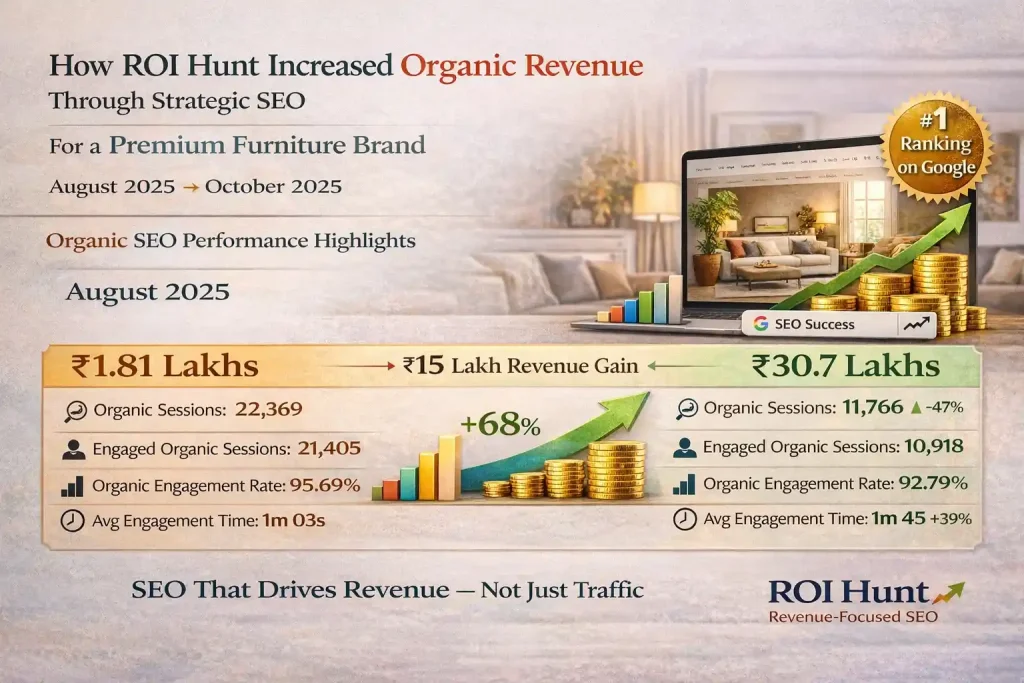
Performance Comparison: August 2025 vs October 2025 (Organic Search Only)
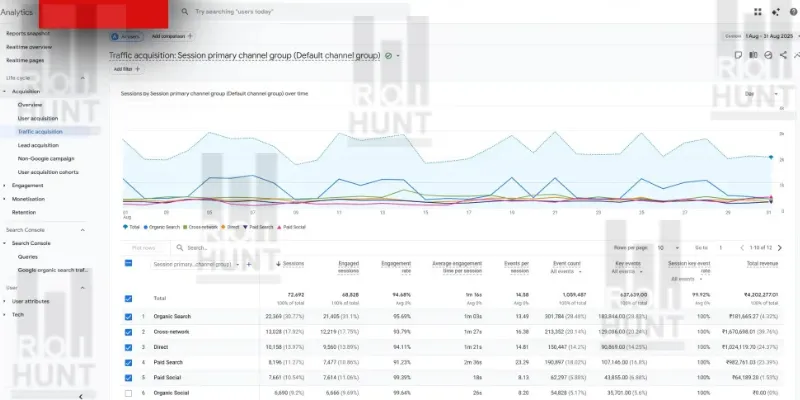
🔹 August 2025 – Organic Search Snapshot
- – Organic Sessions: 22,369
- – Engaged Organic Sessions: 21,405
- – Organic Engagement Rate: 95.69%
- – Avg Engagement Time: 1m 03s
- – Organic Revenue: ₹1.81 Lakhs (approx.)
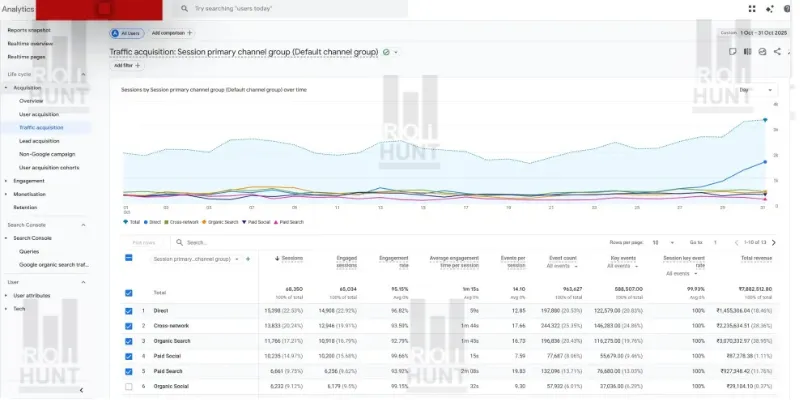
🔹 October 2025 – Organic Search Snapshot
- – Organic Sessions: 11,766
- – Engaged Organic Sessions: 10,918
- – Organic Engagement Rate: 92.79%
- – Avg Engagement Time: 1m 45s
- – Organic Revenue: ₹30.7 Lakhs (approx.)
Key Insight: Fewer Sessions, Higher Revenue
While October saw lower organic session volume compared to August, organic revenue increased significantly.
This highlights a critical SEO truth:
Quality of organic traffic matters more than quantity.
ROI Hunt successfully shifted the focus from traffic growth to revenue efficiency per session.
Key Improvements Implemented
1. Higher-Intent Organic Traffic
SEO efforts attracted users closer to purchase readiness, leading to:
- – Better product discovery
- – Stronger category engagement
- – Higher conversion probability
2. Improved Session Quality
Despite fewer sessions:
- – Users spent more time per session
- – Engagement remained consistently above 92%
- – Bounce behavior reduced significantly
3. Strong Revenue Contribution from SEO
In October:
- – Organic Search became one of the top revenue-driving channels
- – Contributed ~₹30.7 Lakhs in revenue, purely from SEO
This validated SEO as a profit center, not just a traffic channel.
Why This SEO Strategy Worked
1. Revenue-First SEO
Instead of chasing rankings alone, every decision was tied to:
- – Buyer intent
- – Commercial value
- – Category profitability
2. Long-Term Keyword Equity
SEO improvements built compounding value—results strengthened over time rather than resetting each month.
3. Engagement as a Ranking Signal
High engagement rates reinforced Google’s trust in:
- – Page relevance
- – Content usefulness
- – Brand authority
Helping maintain rankings even during seasonal traffic shifts.
The Results (Organic Search Only)
📈 SEO Impact Summary
- – Strong, consistent organic engagement (>92%)
- – Improved average engagement time
- – Organic revenue scaled to ~₹30.7 Lakhs in October
- – SEO established as a sustainable growth channel
Conclusion
This case study demonstrates that effective SEO is not about chasing traffic spikes—it’s about building revenue stability.
By focusing on:
- – Intent-led optimization
- – Category-level SEO
- – Engagement-driven performance
ROI Hunt helped a premium furniture brand turn organic search into a predictable, high-ROI revenue engine.
If you’re looking for an SEO agency that prioritizes revenue, not vanity metrics, ROI Hunt delivers results that compound month after month.