
How ROI Hunt Generated 10.88 Lakh in Revenue in 30 Days Using Performance Marketing
Performance marketing has become the backbone of scalable ecommerce growth. However, without disciplined budget control, continuous optimisation, and clear performance ownership, scaling paid campaigns often leads to rising costs and declining returns.
A fast-growing ecommerce brand partnered with ROI Hunt, a performance marketing company in India, to drive profitable growth while maintaining strong efficiency across paid channels.
The objective was clear:
Scale revenue aggressively without compromising ROAS.
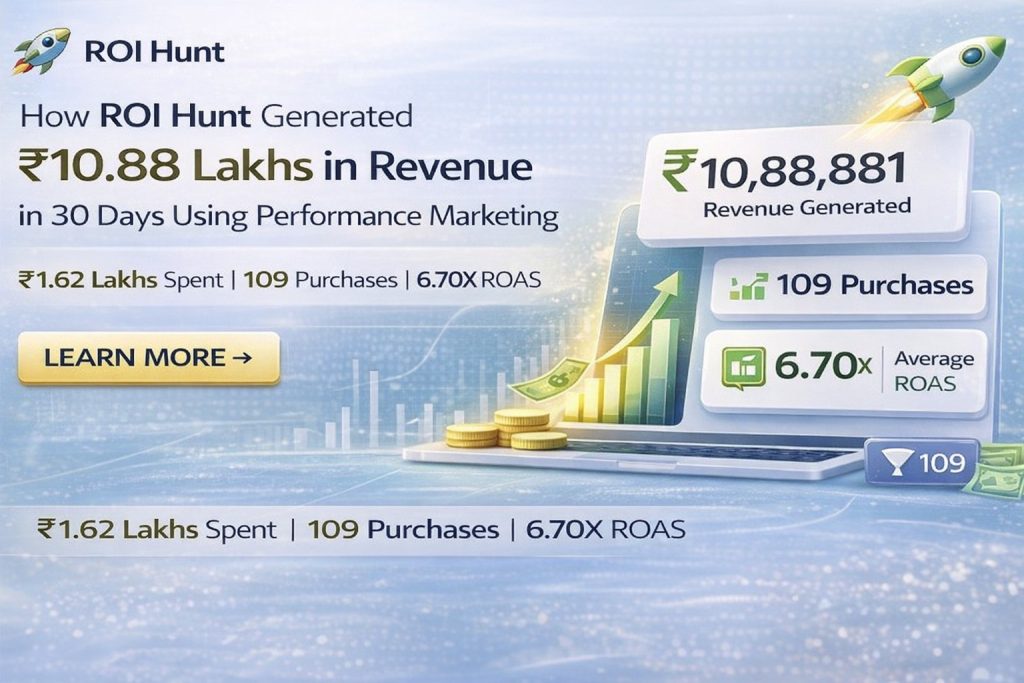
The Results
- – ₹10,88,881 in revenue
- – ₹1,62,420 in ad spend
- – 109 website purchases
- – 6.70× average ROAS in 30 days
This case study explains how ROI Hunt achieved these results using a structured, performance-first marketing framework.
The Challenge
Before working with ROI Hunt, the brand faced several common challenges seen in scaling ecommerce ad accounts.
1. Scaling Spend Without Efficiency Loss
Previous scaling attempts resulted in fluctuating ROAS and inconsistent purchase performance. Increasing budgets often caused efficiency to drop.
2. Multiple Campaigns with Mixed Performance
The account had several active campaigns running simultaneously, but spend allocation was not aligned with performance contribution.
3. Cost Control at Scale
As spend increased, even minor inefficiencies had a significant impact on overall profitability. The brand needed tighter control over cost per purchase and budget distribution.
The brand required a performance marketing agency focused on revenue and ROAS, not vanity metrics.
The ROI Hunt Approach
ROI Hunt implemented its Performance-First Paid Media Framework, designed to scale ecommerce revenue profitably.
1. Purchase-Focused Optimisation
All campaigns were optimised strictly for website purchases, ensuring algorithms prioritised high-intent users over low-quality traffic.
2. Strategic Budget Reallocation
Budgets were dynamically adjusted based on:
- – Purchase volume
- – Cost per purchase stability
- – ROAS consistency
High-performing campaigns were scaled, while underperforming campaigns were paused or limited.
3. ROAS-Led Scaling Strategy
Instead of blanket scaling, budgets were increased only where ROAS benchmarks were consistently met, protecting profitability during scale.
4. Continuous Performance Monitoring
Campaigns were monitored daily to track:
- – Cost per purchase
- – ROAS trends
- – Revenue contribution by campaign
This ensured performance stability throughout the month.
Campaign Execution
During the 30-day performance window:
- – ₹1,62,420 was spent efficiently
- – 109 purchases were recorded
- – ₹10,88,881 in revenue was generated
- – Average ROAS remained strong at 6.70×
Several campaigns delivered ROAS ranging from 5× to 22×, contributing significantly to overall account performance.
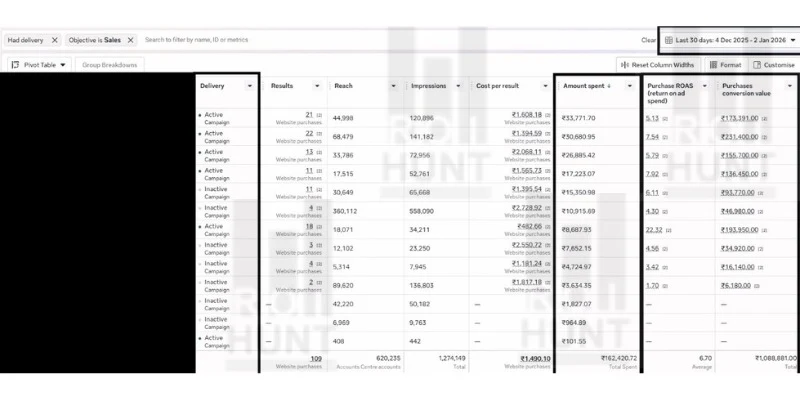
The Results (Campaign Performance Summary)
| Metric | Result |
|---|---|
| Total Ad Spend | ₹1,62,420 |
| Total Revenue | ₹10,88,881 |
| Total Purchases | 109 |
| Average ROAS | 6.70× |
| Highest Campaign ROAS | 22.32× |
For every ₹1 spent on ads, the brand generated ₹6.70 in revenue.
Why This Performance Marketing Strategy Worked
1. Revenue-First Decision Making
Every optimisation decision was driven by purchase and revenue data, not impressions or clicks.
2. Smart Scaling with Cost Control
Spend was increased only where efficiency benchmarks were maintained.
3. End-to-End Performance Ownership
ROI Hunt owned performance outcomes, not just campaign setup or reporting.
Conclusion
This case study demonstrates how ecommerce brands can scale profitably with a performance-first marketing approach.
By applying a structured paid media strategy, ROI Hunt helped generate ₹10.88 Lakh in revenue in 30 days while maintaining a strong 6.70× ROAS.
If you’re looking for a performance marketing company in India that focuses on scalable, measurable growth, ROI Hunt builds systems designed for sustainable performance.