
Performance Marketing Case Study: 91K Ad Spend to 4.29 Lakh Revenue (4.70x ROAS)
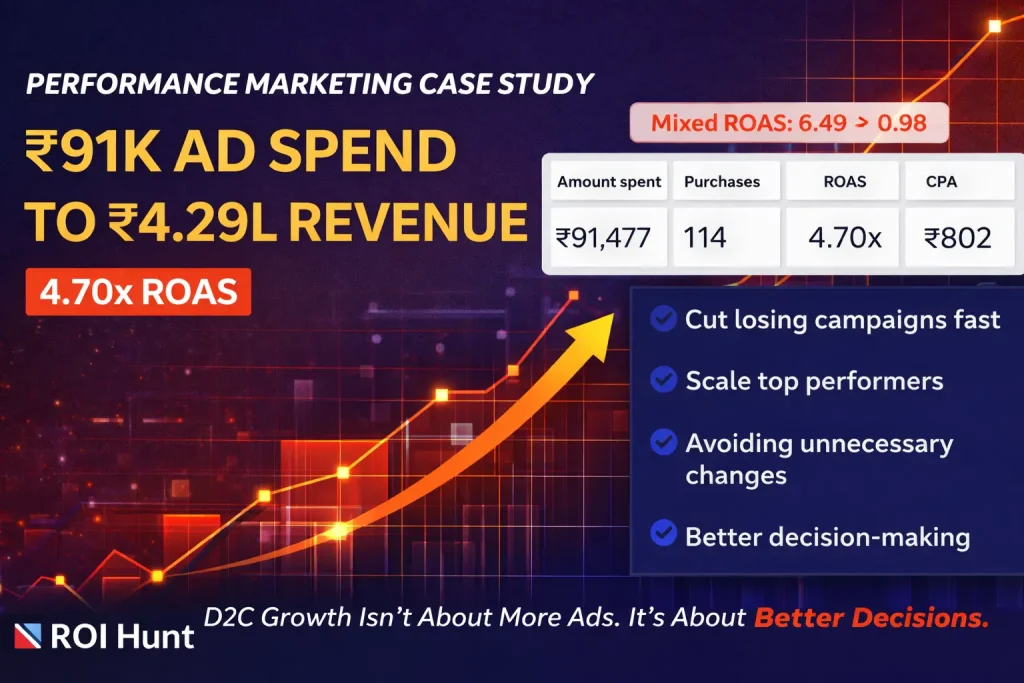
₹91,477 spent.
₹4,29,569 revenue generated.
114 purchases at ₹802 CPA.
Looks decent on the surface.
But the real story is deeper 👇
One campaign delivered 6.49x ROAS.
Another dropped to 0.98x.
Same account.
Same audience.
So what changed?
This performance marketing case study by ROI Hunt breaks down how better decision-making — not more ads — drove profitability in a D2C PPC setup.
The Objective
– Drive profitable website purchases using PPC campaigns
– Maintain consistent ROAS across campaigns
– Reduce wasted ad spend
– Improve CPA efficiency
– Build a scalable performance marketing system
The Challenge
– Mixed campaign performance within the same account
– Budget getting distributed across inefficient campaigns
– Difficulty in identifying what to scale vs what to stop
– Risk of over-optimizing already working campaigns
– Hidden losses behind average ROAS
Performance varied from:
– 6.49x ROAS (profitable)
– 0.98x ROAS (loss-making)
That’s not a targeting issue.
That’s a decision-making gap.
The Strategy: Decisions Over Activity
1. Campaign-Level Clarity (No Averages)
Instead of relying on overall ROAS:
– Each campaign analyzed individually
– Winners and losers clearly separated
– Budget decisions made at micro level
👉 No more “blended illusion”
2. Killing Losers Fast
– Campaigns below break-even paused quickly
– No emotional attachment to underperformers
– Budget leakage stopped early
👉 Speed = profitability
3. Scaling Winners Aggressively
High-performing campaigns (6+ ROAS) were:
– Scaled with controlled budget increases
– Duplicated for expansion
– Given majority budget share
👉 Winners drove growth
4. Avoiding Over-Optimization
Most brands break winning campaigns by over-tweaking.
We:
– Maintained stability in high-performing campaigns
– Avoided unnecessary changes
– Let performance compound
👉 Stability protects ROAS
5. Budget Reallocation System
– Spend shifted from low → high efficiency campaigns
– Daily monitoring of CPA and ROAS
– Data-led decision making
Results (Last 30 Days)
Performance Snapshot
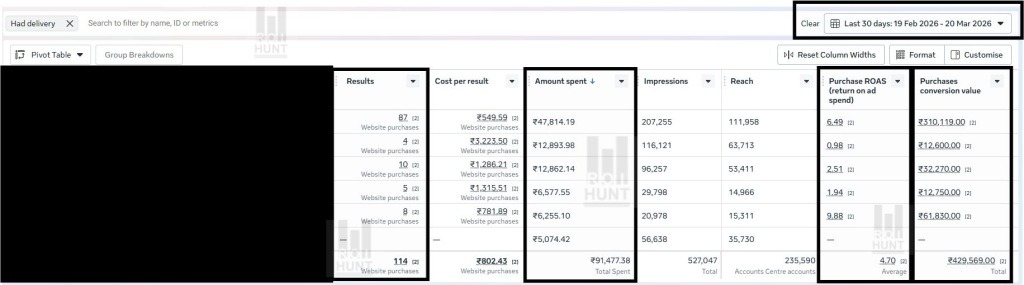
– Total Ad Spend: ₹91,477
– Tracked Revenue: ₹4,29,569
– Website Purchases: 114
– Average ROAS: 4.70x
– Top Campaign ROAS: 6.49x
– Lowest Campaign ROAS: 0.98x
– Average CPA: ₹802
What This Means
– Every ₹1 generated ₹4.7 in revenue
– Profit driven by a few strong campaigns
– Weak campaigns diluted overall performance
– Better decisions directly improved efficiency
👉 Growth came from optimization — not more spend
Why This Campaign Worked
Fast Decision-Making
Losers were cut before wasting budget
Aggressive Scaling
Winning campaigns were pushed harder
System-Based Budget Allocation
Money followed performance
Stability Over Noise
Winning campaigns were not over-optimized
Profit-First Thinking
ROAS and CPA controlled every move
Conclusion
Most D2C brands don’t have a scaling problem.
They have a decision-making problem.
Same account.
Same audience.
Different results.
The difference wasn’t strategy.
It was execution.
👉 Cut losers fast
👉 Scale winners aggressively
👉 Don’t touch what’s working
That’s how performance marketing becomes predictable.
Because D2C growth isn’t about running more ads.
It’s about making better decisions.