
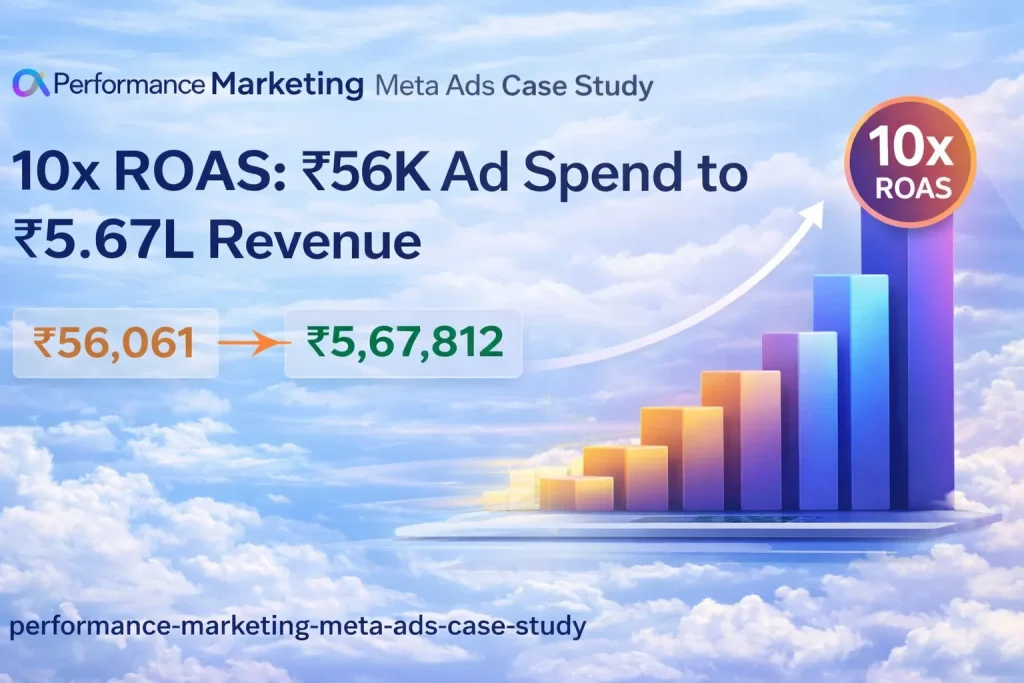
Performance Marketing Meta Ads Case Study: Rs56K Ad Spend to Rs5.67L Revenue in 30 Days (10.13x ROAS)
The last 30 days did not just show advertisements.
We ran a machine that performed.
This case study illustrates how ROI Hunt, as a well-organized business, achieves increased revenue performance via systematic Meta Ads execution, not based on an emotional scale, but rather on a lot of data-driven analysis.
The Objective
- – Increase the number of profitable purchases through the use of Meta ads
- – Maintain a double-digit ROI, while scaling
- – improve the effectiveness of campaigns across cold and warm audience
- – Create a revenue engine that is structured
- – Optimize the campaign to improve the profitability of purchases rather than engagement
The Challenge
- – Budget control (~Rs56K total expenditure)
- – Multiple campaigns that are performing at different levels of ROAS
- – Must find scalable winners quickly
- – Beware of scaling low-efficiency ads
- – to maintain the profitability of the campaign while increasing volumes
The Strategy: Efficiency Over Emotion
1. Revenue-First Campaign Structure
Campaigns were specifically designed to:
- – Website purchases
- – Cost-per-purchase benchmarks
- – ROAS stability
As an analytics-driven Facebook marketing company We don’t grow by CTR or other vanity indicators that are not based on purchase revenue.
2. Efficiency-Based Scaling
Here’s the biggest mistake brands make wrong:
They take what appears nice.
We increased the size of the amount that seemed to be statistically profitable.
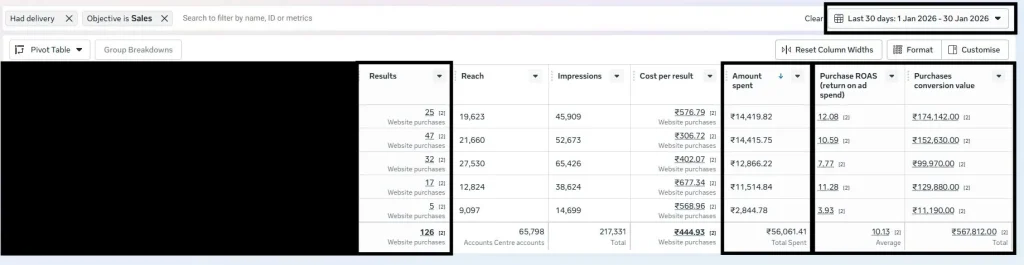
- – One campaign raked in 12.08x ROAS
- – Another barely even 3.93x ROAS
Instead of using a mix approach budget was shifted to high-efficiency clusters.
We measured the efficiency of our machines, not our emotions.
3. Creative Angle Optimization
The difference in performance didn’t originate solely from the audience.
We:
- – Tried positioning angles
- – improved hook-message-offer alignment
- – Sequenced creatives to combat cold – warm and retargeting
We have optimized angles, not only for audiences.
This is an important differentiator in the field of advanced performance marketing.
4. Cold + Retargeting Synergy
Instead of campaigns that are purely focused:
- – Cold traffic led to competent buyers
- – Retargeting nurtured buyers with high-intent
- – The messaging evolved according to the purchase stage
The result? Constructed conversion flow, instead of scattered traffic.
5. ROAS-Led Budget Discipline
Scaling decisions were controlled by:
- – Revenue per Rs1 spent
- – CPA stability
- – Conversion consistency
There are no gimmicks.
No hacks.
Only profitability signals.
Results (Last 30 Days)
Performance Snapshot
- – Total Ad Spend: Rs56,061
- – Tracked Purchase Revenue: Rs5,67,812
- – Website Purchases: 126
- – Average ROAS: 10.13x
- – Top Campaign ROAS: 12.08x
What This Means
- Each spent rupee earned Rs10.13 of revenues
- Budget for scalable up without collapse of efficiency
- There was a clear distinction between weak and scalable campaigns
- Revenue is influenced by the structure of the campaign not randomness
Why This Worked
Ruthless Revenue Focus
Optimization is directly linked to the purchase value.
Controlled Scaling
High-ROAS clusters were given priority funding.
Angle-Based Creative Testing
The process of messaging is refined and systematically.
Full-Funnel Continuity
Cold + Retargeting was used as one acquisition system.
Lean Optimization Framework
A smaller number of variables means more algorithmic signals.
Conclusion
The Meta Ads case study proves the reality of Performance marketing is like.
When the buying of media meets strategy,
when scaling is based on the data
where clarity determines decisions
The Rs56K price doesn’t last forever.
It is Rs5.67L.
It’s the difference between ad campaigns …