
Performance Marketing Meta Ads Case Study: 84K Ad Spend to 5.58L Revenue (6.64x ROAS)
Most D2C brands don’t have a marketing problem.
They have a math problem.
In the last 30 days, we didn’t just run Meta ads.
We engineered unit economics.
This case study shows how a structured performance marketing company turned ₹84,089 into ₹5,58,581 in tracked revenue — while exposing the difference between “average performance” and scalable efficiency.
The Objective
- – Drive profitable website purchases via Meta Ads
- – Maintain strong ROAS while managing cold + retargeting
- – Identify scalable campaigns without killing efficiency
- – Improve offer–creative–stage alignment
- – Build a repeatable revenue engine (not random wins)
The Challenge
- – Budget capped at ₹84K
- – Cold + retargeting running simultaneously
- – Large ROAS gap between campaigns
- – Avoid scaling low-efficiency ad sets
- – Protect contribution margin while increasing volume
Same product.
Same funnel.
Same team.
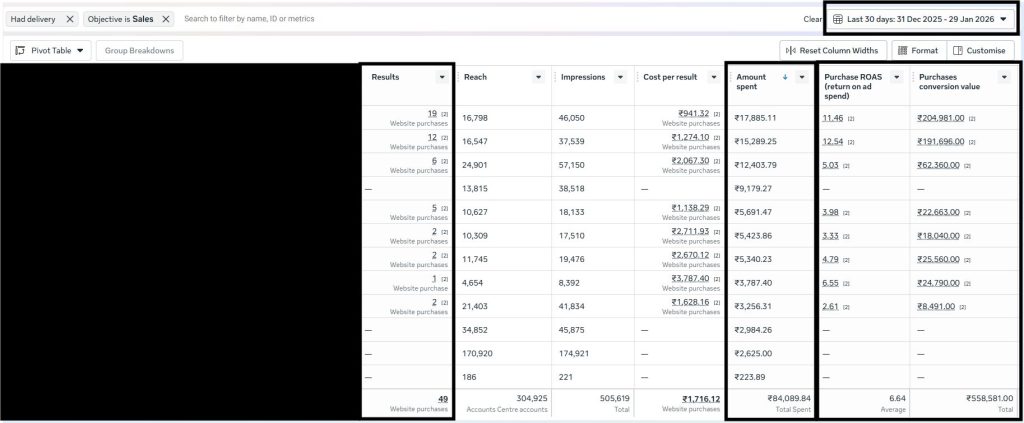
Yet performance ranged from 2.61x to 12.54x ROAS.
That’s not traffic variation.
That’s structural variation.
The Strategy: Fix the Math Before Scaling
1. Unit Economics First, Traffic Second
Most D2C brands try to scale traffic.
We scaled numbers.
We evaluated:
- – AOV vs CPA
- – Conversion rate consistency
- – Revenue per ₹1 spent
- – Break-even ROAS thresholds
Ads were judged on cash flow impact — not CTR.
2. Efficiency-Based Budget Allocation
Campaign results showed:
- – Top performer: 12.54x ROAS
- – Lowest performer: 2.61x ROAS
- – Account average: 6.64x ROAS
Instead of equal distribution:
- – The budget was shifted toward statistically stable winners
- – Low-efficiency campaigns were controlled, not emotionally scaled
- – Scaling was gradual to protect the learning phase stability
We don’t scale what “looks good.”
We scale what survives numbers.
3. Offer & Creative Angle Optimization
The product didn’t change.
The math did.
Performance difference came from:
- – Sharper value positioning
- – Stronger hook-message-offer alignment
- – Creative built for the buying stage awareness
- – Clear problem → solution framing
In D2C, creative isn’t decoration.
It’s margin control.
4. Buying Stage Mapping (Cold + Retargeting Sync)
Instead of isolated campaigns:
- – Cold ads filtered intent
- – Retargeting captured high-intent users
- – Messaging evolved across funnel stages
- – Purchase psychology matched awareness level
This built a structured conversion flow.
Not scattered impressions.
5. ROAS-Led Scaling Discipline
Scaling decisions were controlled by:
- – Revenue per ₹1 spent
- – CPA stability
- – Conversion consistency
- – Margin protection
No hacks.
No hype.
Just profitability signals.
Results (Last 30 Days)
Performance Snapshot
- – Total Ad Spend: ₹84,089
- – Tracked Purchase Revenue: ₹5,58,581
- – Website Purchases: 49
- – Average ROAS: 6.64x
- – Top Campaign ROAS: 12.54x
- – Lowest Campaign ROAS: 2.61x
What This Actually Means
- – Every ₹1 generated ₹6.64 in revenue
- – Revenue concentration was driven by high-efficiency clusters
- – Creative + offer alignment directly impacted ROAS variance
- – Scaling potential existed — but only through controlled allocation
The difference between 2.61x and 12.54x isn’t luck.
Its structure.
Why This Worked
Ruthless Revenue Focus
Optimization is tied directly to purchase value.
Budget Discipline
High-efficiency campaigns received priority capital.
Angle-Based Testing
We optimized positioning — not just audiences.
Full-Funnel Continuity
Cold + Retargeting worked as one acquisition system.
Business-Level Thinking
Ads were treated as financial levers, not marketing experiments.
Conclusion
In D2C, every ad is a cash flow lever.
If AOV, CAC, and conversion rate don’t align —
No amount of scaling saves you.
This campaign didn’t just generate revenue.
It validated the math behind the business.
₹84K didn’t become ₹5.58L by accident.
It became ₹5.58L because numbers were respected.