
Performance Marketing Case Study: 1.46Lakh Ad Spend to 11.3Lakh Revenue in 30 Days
This case study highlights how a lean, structured performance marketing approach delivered strong, measurable business outcomes—without relying on viral creatives or experimental gimmicks.
Instead of treating paid media as a creative playground, the account was managed like a revenue-driving business function, with clear performance benchmarks, disciplined budget allocation, and outcome-led optimization.
The Objective
- – Drive profitable purchases, not just traffic
- – Maintain high ROAS at scale
- – Avoid wasteful testing and creative overload
- – Build predictable performance within a lean ad account
The Challenge
- – Limited ad spend with high expectations
- – No dependency on viral hooks or trend-based creatives
- – Need for consistent performance, not spikes
- – Focus on conversion efficiency, not vanity metrics
The Strategy: Performance Over Experiments
1. Revenue-First Account Structure
Campaigns were structured around purchase intent, not awareness or engagement. The budget was directed only toward campaigns that demonstrated clear conversion signals early.
2. Controlled Testing, Not Creative Chaos
Instead of testing dozens of hooks blindly:
- – Only high-intent creatives were deployed
- – Messaging focused on clarity, value, and trust
- – Poor-performing ads were cut quickly
This kept learning costs low and performance stable.
3. ROAS-Led Budget Allocation
Spend was dynamically shifted toward:
- – Campaigns with consistent purchase volume
- – Ad sets showing lower cost per purchase
- – High-ROAS performers with room to scale
Top-performing campaigns were scaled cautiously to protect efficiency.
4. Clean Tracking & Attribution
Only tracked purchase data was used to evaluate success.
No inflated metrics, no soft conversions—just revenue.
Results (Last 30 Days)
Performance Snapshot:
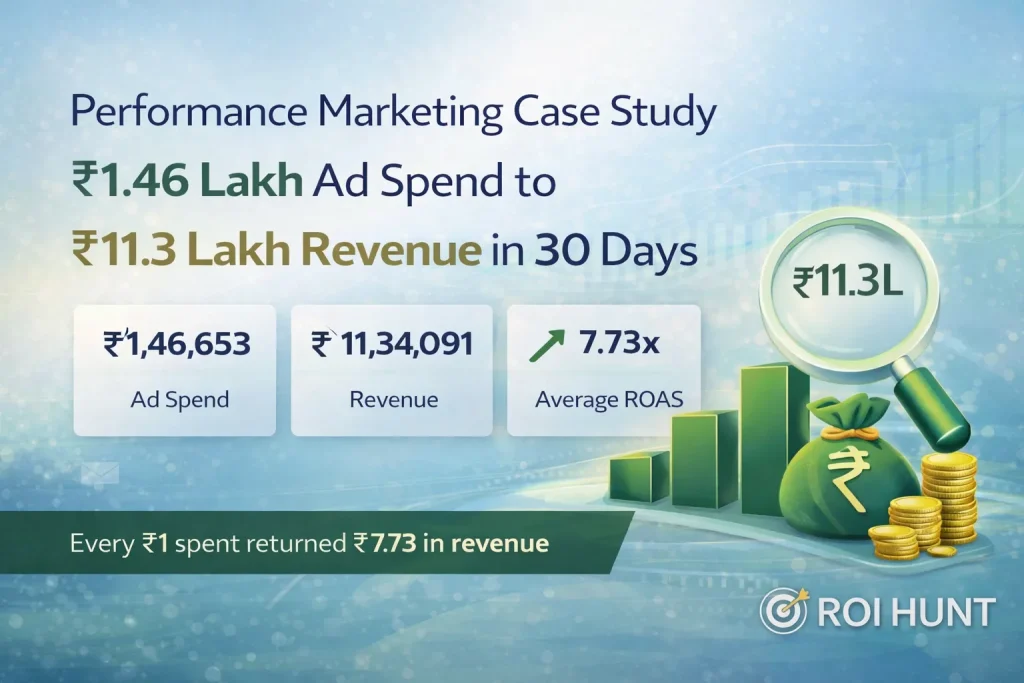
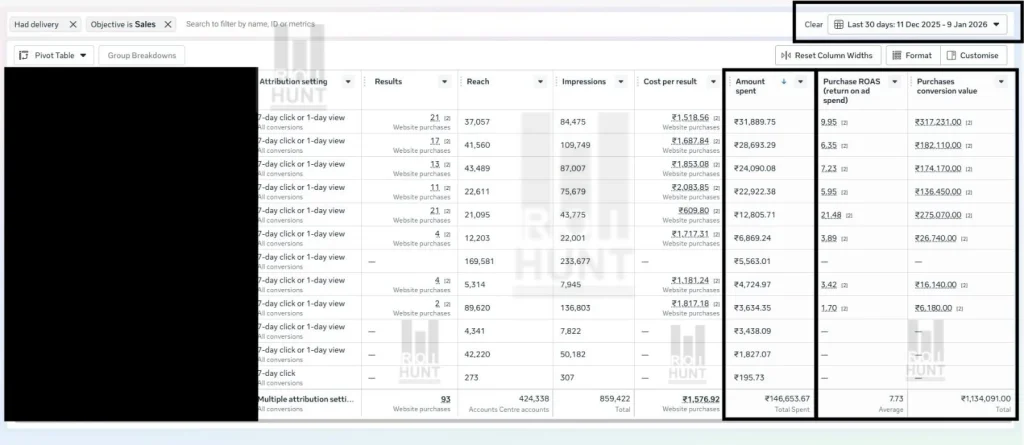
- – Total Ad Spend: ₹1,46,653
- – Tracked Purchase Revenue: ₹11,34,091
- – Average ROAS: 7.73
- – Peak Campaign ROAS: 21.48
Performance Marketing Case Study_ ₹1.46Lack to ₹11.3Lack
What This Means:
- – Every ₹1 spent returned ₹7.73 in revenue
- – One campaign significantly outperformed benchmarks
- – Strong profitability achieved without aggressive scaling
Why This Worked
✔ Business-Driven Thinking
Decisions were made based on profitability, not experimentation for experimentation’s sake.
✔ Lean Account Discipline
Fewer campaigns, fewer variables, clearer insights.
✔ Focus on What Converts
No viral gimmicks.
No “let’s test 100 hooks and pray.”
Only strategies that directly supported purchases.
✔ Scalable, Sustainable Model
Performance remained stable even as spend increased—laying the foundation for long-term growth.
Conclusion
This case study proves that ROI HUNT performance marketing works best when it’s treated like a business function, not a creative guessing game.
With a disciplined strategy, clear metrics, and revenue-first optimization, it’s possible to generate strong returns even with limited budgets.
If you’re looking to turn paid media into a predictable revenue channel—this is how it’s done.