
Performance Marketing Meta Ads Case Study: 62K Ad Spend to 8.75Lack Revenue in 30 Days (13.92x ROAS)
The last 30 days did not rely on luck or a viral creative.
We built a controlled performance system.
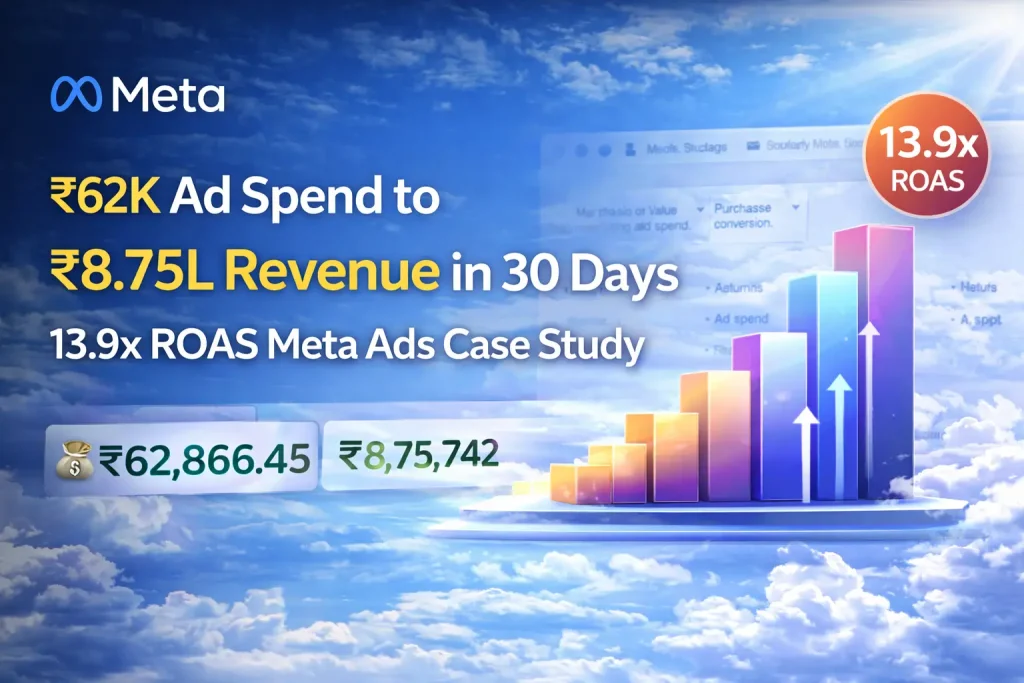
This case study shows how a structured approach by a performance marketing company — not emotional scaling — generated ₹8,75,274.35 in revenue from ₹62,866.45 in ad spend while maintaining efficiency at scale.
The Objective
- – Increase profitable website purchases through Meta Ads
- – Maintain double-digit ROAS while scaling
- – Improve campaign efficiency across cold and warm audiences
- – Build a stable acquisition engine
- – Scale without breaking CPA stability
The Challenge
- – Budget cap (~₹62K total spend)
- – Multi-ad-set environment with performance variation
- – Need to scale only statistically stable performers
- – Avoid performance drop during budget increases
- – Maintain margin protection while increasing volume
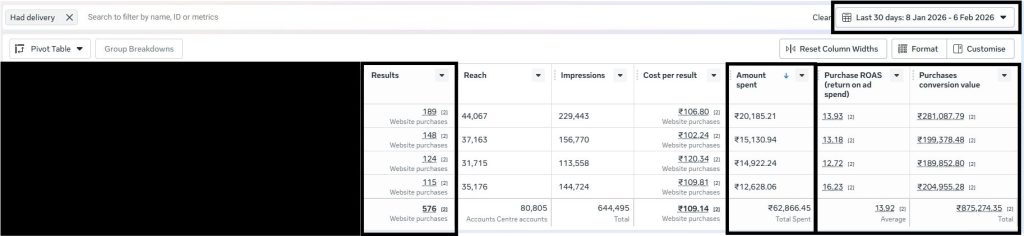
Performance ranged between:
- – 16.23x ROAS (top performer)
- – 12.72x ROAS (lowest in winning cluster)
The gap wasn’t dramatic — because inefficiency was eliminated early.
The Strategy: Efficiency Over Emotion
1. Revenue-First Campaign Structure
Campaigns were designed specifically for:
- – Website purchases
- – Stable cost per result
- – Revenue per ₹1 spent
- – Consistent conversion behavior
No optimization for vanity metrics.
No decision-making based on CTR spikes.
Revenue-controlled direction.
2. Efficiency-Based Scaling
Here’s where most accounts break:
They scale too early.
Instead:
- – Budget increased only after CPA stability
- – ROAS consistency validated over multiple days
- – Scaling increments limited to 20–30%
- – Weak ad sets paused immediately
One cluster averaged 13.93x ROAS.
Another maintained 16.23x ROAS.
Scaling followed mathematical proof — not excitement.
3. Creative Angle Optimization
The performance strength came from:
- – Clear positioning
- – Strong offer framing
- – Direct value communication
- – Audience-aligned messaging
Creatives were rotated before fatigue appeared.
Angles were tested before budgets were increased.
Performance stability begins with message clarity.
4. Cold + Retargeting Synergy
Instead of isolated campaigns:
Cold traffic:
- – Filtered qualified buyers
- – Tested scalable interest pools
Retargeting:
- – Captured engaged users
- – Reinforced offer conviction
- – Stabilized CPA volatility
This created one acquisition system — not disconnected funnels.
5. ROAS-Led Budget Discipline
Every scaling decision was controlled by:
- – CPA stability
- – Revenue trend consistency
- – Margin protection
- – Conversion predictability
No panic edits.
No impulsive duplication.
Only controlled expansion.
Results (Last 30 Days)
Performance Snapshot
- – Total Ad Spend: ₹62,866.45
- – Tracked Purchase Revenue: ₹8,75,274.35
- – Website Purchases: 576
- – Average CPA: ₹109.14
- – Average ROAS: 13.92x
- – Highest Ad Set ROAS: 16.23x
What This Means
Each ₹1 generated nearly ₹14 in revenue.
Budget increased without collapse in efficiency.
Scaling maintained margin strength.
Creative testing protected long-term stability.
This wasn’t a spike.
It was a controlled system.
Why This Worked
Ruthless Revenue Focus
Optimization tied directly to purchase value.
Controlled Scaling
High-ROAS clusters received priority funding.
Creative Discipline
Angles refined before increasing spend.
Full-Funnel Continuity
Cold + retargeting functioned as one system.
Lean Optimization Framework
Fewer variables. Stronger algorithm signals.
Conclusion
Performance marketing is not about chasing high ROAS screenshots.
It’s about building a system that survives budget increases.
₹62K → ₹8.75L
Not because of one lucky ad.
But because efficiency was protected while scaling.
High ROAS looks impressive.
Sustainable ROAS builds businesses.