
How ROI Hunt Helped an Ecommerce Brand Generate 17.14 Lakhs in 30 Days Using Meta Ads
Meta Ads (Facebook & Instagram) continue to be one of the most powerful growth channels for ecommerce brands. However, with rising competition, increasing CPMs, and constantly evolving algorithms, most brands struggle to achieve profitable scale.
Many ecommerce businesses spend aggressively on Meta Ads but fail to see consistent returns due to poor campaign structure, weak creatives, and lack of performance-led optimisation.
A growing ecommerce brand approached ROI Hunt, a performance-driven Meta Ads/ Facebook Advertising Agency, with a clear goal — to generate consistent website purchases while maintaining strong profitability.
What followed was a focused, data-backed Meta Ads strategy that delivered:
- – 320 website purchases
- – ₹17,14,971 in revenue
- – ₹1,10,233.70 ad spend
- – 15.56x ROAS in just 30 days
This case study explains how ROI Hunt engineered these results and how ecommerce brands can replicate the same success using a structured Facebook advertising strategy.
The Challenge
Before working with ROI Hunt, the ecommerce marketing brand was facing challenges common across many Meta Ads accounts:
1. Inconsistent Sales from Meta Ads
The brand had previously run Facebook and Instagram ads but struggled with unpredictable sales volume. Some days performed well, while others showed minimal returns.
There was no stable system to generate purchases consistently.
2. Poor ROAS Control While Scaling
Whenever ad spend was increased, ROAS dropped sharply. Scaling felt risky, and profitability suffered as budgets grew.
The brand needed a Facebook advertising agency that could scale without sacrificing margins.
3. Inefficient Campaign Structure
Campaigns were fragmented, overlapping audiences competed against each other, and Meta’s learning phase kept resetting.
This resulted in wasted spend and unstable performance.
4. Creative Fatigue & Weak Messaging
Existing ad creatives lacked clear hooks and emotional triggers. Performance dropped quickly due to creative fatigue, increasing cost per purchase.
5. No Clear Performance Framework
Optimisations were reactive rather than strategic. Decisions were not driven by structured performance benchmarks.
The brand needed a results-focused Meta Ads partner — not just media buying, but performance ownership.
The ROI Hunt Approach
ROI Hunt applied its Performance-First Meta Ads Framework, designed specifically for ecommerce brands aiming for profitable scale.
1. Conversion-Focused Campaign Architecture
We rebuilt the ad account with a clear focus on Website Purchases as the primary optimisation goal.
- – Simplified campaign structure
- – Reduced audience overlap
- – Stable learning phases
- – Clear funnel visibility
This allowed Meta’s algorithm to optimise efficiently for buyers, not just traffic.
2. Audience Segmentation & Scaling Strategy
We structured audiences into:
- – Warm audiences (website visitors, engagement data)
- – Lookalike audiences based on purchasers
- – Controlled cold audience expansion
Scaling decisions were always ROAS-driven, ensuring profitability remained intact.
3. Creative-Led Optimisation
Instead of relying on targeting alone, we focused heavily on creatives:
- – Multiple creatives tested simultaneously
- – Native, scroll-stopping visuals
- – Clear product value communication
- – Messaging aligned with buyer intent
This reduced creative fatigue and stabilised cost per purchase.
4. Performance-Based Budget Allocation
Budgets were not increased blindly.
Spend was shifted dynamically toward campaigns and ad sets delivering higher ROAS, ensuring every rupee worked harder.
Execution & Optimisation
Campaigns were monitored daily with clear optimisation checkpoints:
- – Creative performance trends
- – Audience efficiency
- – Cost per purchase stability
- – ROAS benchmarks
Underperforming ad sets were paused quickly, while high-performing campaigns were scaled gradually to maintain account stability.
The Results (30-Day Performance)
The impact of ROI Hunt’s Meta Ads strategy was immediate and measurable.
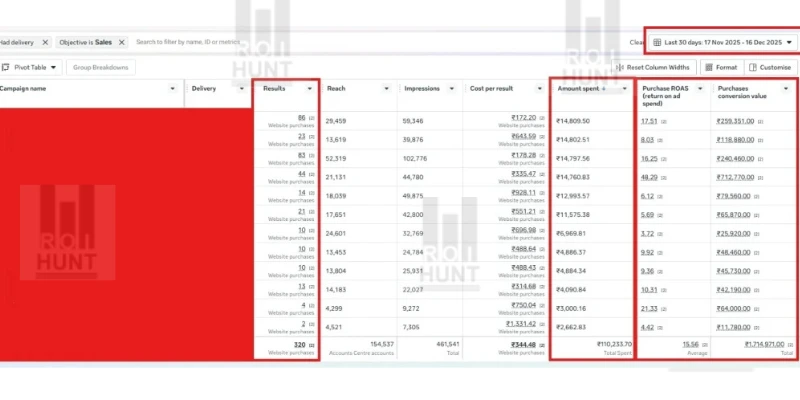
Campaign Performance Overview
- – Total Purchases: 320 website purchases
- – Total Ad Spend: ₹1,10,233.70
- – Total Revenue Generated: ₹17,14,971.00
- – Average ROAS: 15.56x
- – Average Cost per Purchase: ₹344.48
For every ₹1 spent on Meta Ads, the brand generated ₹15.56 in revenue.
Reach & Visibility
- – Total Reach: 1,54,537 accounts
- – Total Impressions: 4,61,541
The campaigns maintained healthy frequency while driving consistent conversions.
Performance Highlights
- – Campaign ROAS ranged from 3.72x to 17.51x
- – One campaign peaked at 48.29x ROAS
- – Even lower-performing campaigns remained profitable
This balance between scale and efficiency ensured stable growth throughout the month.
Why This Meta Ads Strategy Worked
Three key factors drove success:
1. Conversion-First Thinking
Every decision was aligned with purchase optimisation, not vanity metrics.
2. Creative as a Growth Lever
Strong creatives reduced CPA and protected ROAS during scaling.
3. Data-Led Scaling
Budgets were scaled only when performance benchmarks were met.
Conclusion
This case study proves that Meta Ads can still deliver exceptional results for ecommerce brands — when executed with the right strategy.
By combining structured campaign architecture, creative-led optimisation, and ROAS-driven scaling, ROI Hunt helped an ecommerce brand generate ₹17.14 lakhs in revenue in just 30 days with a 15.56x ROAS.
If you’re looking for a Meta Ads / Facebook Advertising Agency that focuses on profitability, not just spend, ROI Hunt delivers performance you can measure.