
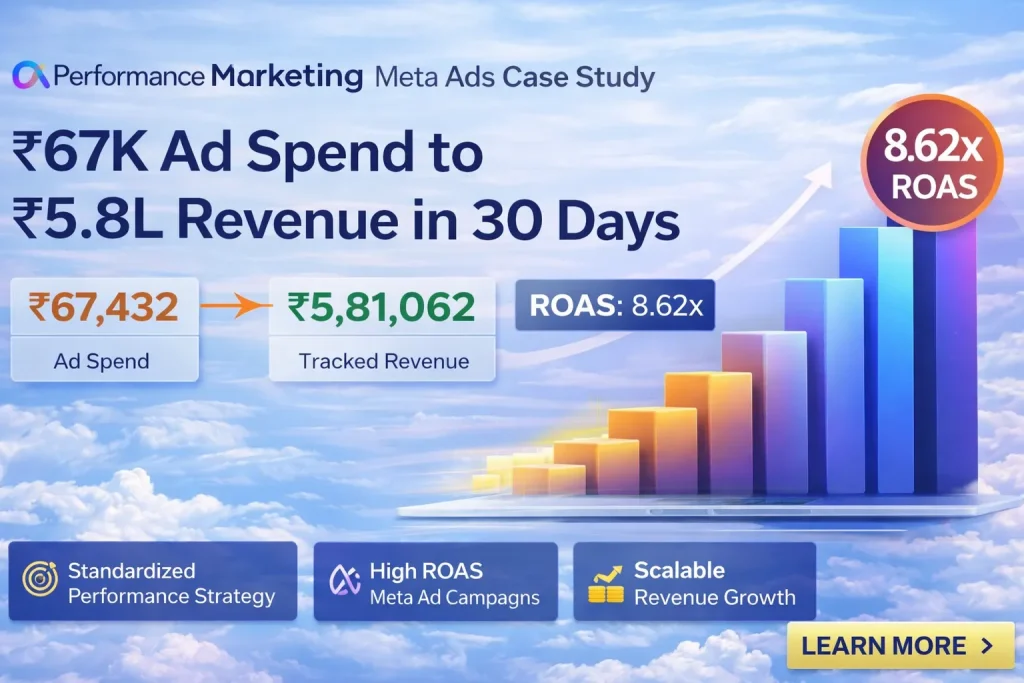
Meta Ads Case Study: Rs67K Ad Spend to Rs5.8L Revenue in 30 Days
The majority of brands do not have a problem with marketing. They’re struggling with their decision-making.
This case study illustrates the way in which ROI Hunt as a standardized performance-based marketing company, has transformed transparency into revenue scalable using Meta Ads — without hacks, false metrics or vanity reporting.
The Objective
- – Drive ecommerce purchases that are profitable with Meta Ads
- – Ensure you have a high ROAS using controlled advertising spend
- – Create an automated acquisition process that is predictable
- – to eliminate irrelevant metrics from the optimization process
- – improve the efficiency of click-to-checkout
The Challenge
- – Budget: Limited (Rs67K total expenditure)
- – Highly competitive e-commerce market
- – The pressure to create predictable, sustainable revenue
- – Beware of testing too much that can burn your budget
- – Increase purchasing volume
The Strategy: Clarity Over Complexity
1. Offer & Audience Clarity First
Prior to advertising was scaled, ROI Hunt aligned:
- – A clear purpose of value
- – clearly defined buyer’s intent
- – A message-market match
The majority of brands jump into buying media.
As a professional Facebook marketing firm We first address the decision-making layer which is whom we’re targeting and the reason they should purchase.
2. Revenue-First Campaign Structure
The campaigns were designed specifically to meet the following criteria:
- – Purchase events
- – Cost-per-purchase control
- – Stable ROAS signals
There is no optimizing engagement.
No traffic vanity metrics.
Only revenue-based signals.
This is the basis of the disciplined service of performance marketing..
3. Funnel Continuity Optimization
Performance isn’t just about ads.
We ensured:
Consistency in messaging from the advertisement to landing page
- – Reducing purchase friction
- – Better decision-making for purchases
- – A strong intent consistency
If clarity flows across the channel, the efficiency of conversion increases.
4. Structured Retargeting
Instead of a generic remarketing
- – Audience segmented according to the intent level
- – Warm and cold traffic is prioritized
- – Buy-stage messages used
Retargeting increased clarity rather than compensating for poor the targeting.
5. ROAS-Led Scaling Discipline
Scaling decisions were governed and backed by data:
- – The shift of spending is restricted towards reliable performing employees
- – The budget is monitored closely. CPA thresholds closely monitored
- – Budget was increased slowly
There is no emotions in Scaling.
No guesswork.
Only profitability security.
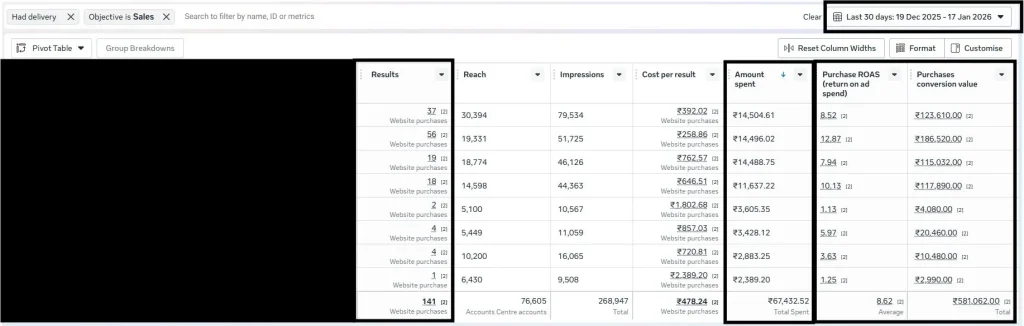
Results (Last 30 Days)
Performance Snapshot
- – Total Ad Spend: Rs67,432
- – Tracked Purchase Revenue: Rs5,81,062
- – Average ROAS: 8.62x
What This Means
- – Every dollar spent produced Rs8.62 of revenue
- – Revenue grew without a collapse of efficiency
- – Performance remained steady for thirty days
- – growth is achieved by implementing a structures, not hacks
Why This Worked
Business-Driven Execution
Every decision is tied to revenue.
Clear Offer Positioning
Conversion began prior to the click.
Lean Account Structure
Fewer variables = stronger optimization signals.
Funnel Alignment
Checkouts and advertisements operate in tandem.
Disciplined Scaling
ROAS is protected during growth.
Conclusion
The Meta Ads case study proves that the best results don’t come from hidden strategies.
They are derived from the clarity.
As an information-driven performance marketing business, ROI Hunt focuses on decision quality firstpurchasing media second.
When clarity is in place,
budget, creatives, and retargeting just increase the effectiveness of what is already in place.