
Meta Ads Case Study: 82K Ad Spend to 3.7Lakh Revenue (4.47x ROAS)
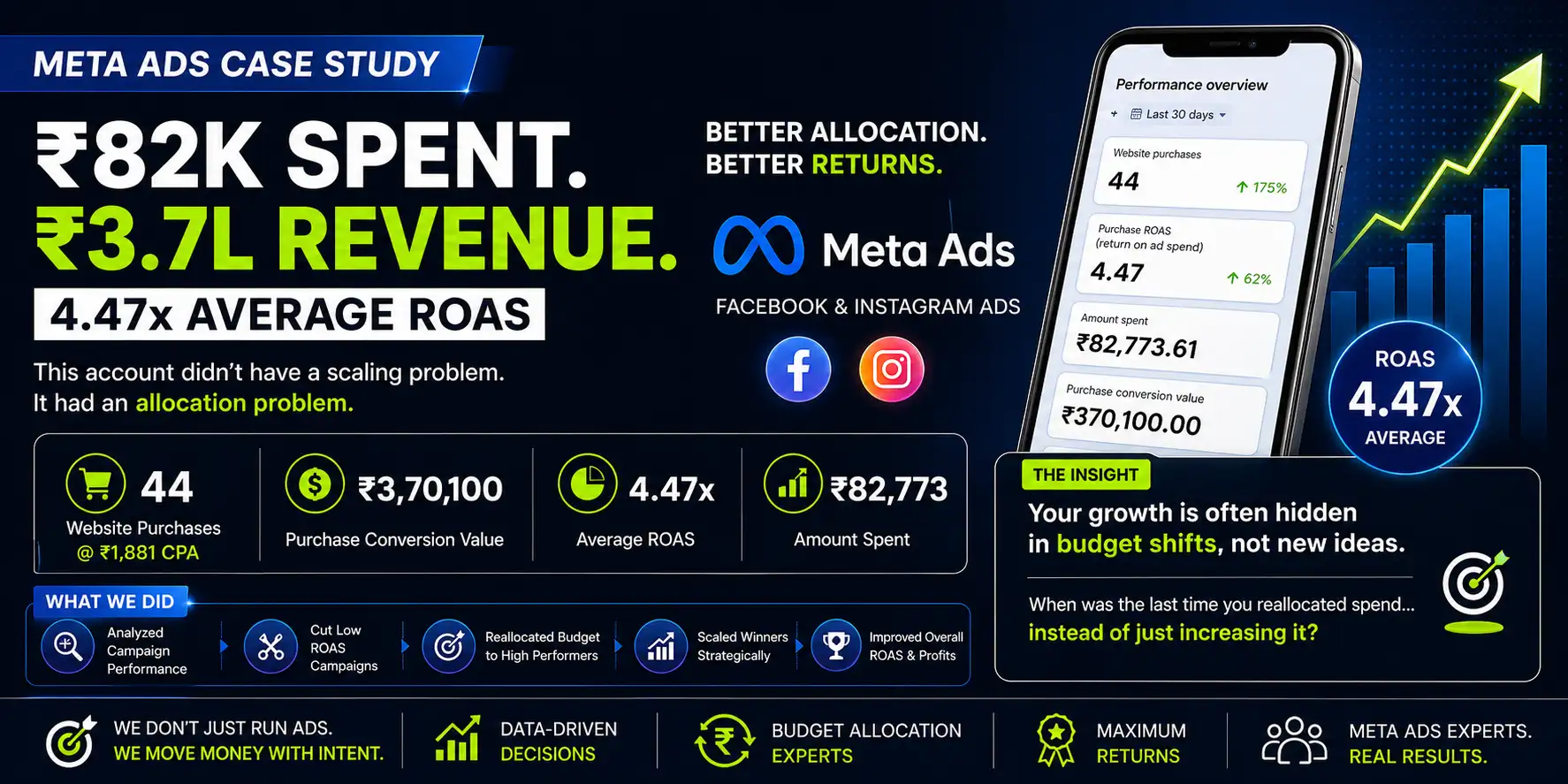
₹82K spent.
₹3.7L revenue generated.
44 purchases at ₹1,881 CPA.
Looks decent.
But not optimized.
Because this account didn’t have a scaling problem.
It had an allocation problem.
A few campaigns were printing returns.
Others were quietly eating the budget.
Same Meta Ads account.
Same audience.
So what changed?
This Meta Ads case study by ROI Hunt, a results-driven best Facebook advertising company, shows how better budget allocation — not new creatives — improved performance.
The Objective
– Drive profitable website purchases using Meta Ads (Facebook & Instagram Ads)
– Improve overall ROAS without increasing spend
– Identify high-performing campaigns quickly
– Reduce budget wastage
– Optimize account-level performance
The Challenge
– Mixed performance across Meta Ads campaigns
– Budget distributed across high and low performers
– Some campaigns generating strong ROAS, others dragging results
– Average ROAS hiding inefficiencies
– No structured allocation strategy
Performance ranged from:
– 9.3x ROAS (top performer)
– 6.9x ROAS (scalable)
– 3.5x ROAS (average)
– 0–1.3x ROAS (loss-making)
That’s not a creative issue.
That’s a budget allocation issue in Meta Ads.
The Strategy: Allocation Over Expansion
1. Performance Marketing Approach to Meta Ads
As a performance marketing and Facebook advertising company, we focused on:
– Revenue per ₹1 spent
– Campaign-level profitability
– ROAS distribution
👉 Not vanity metrics like CTR
2. Campaign-Level Budget Reallocation
Instead of increasing budget:
– Spend was shifted from low → high ROAS campaigns
– Loss-making campaigns were reduced or paused
– High-performing campaigns received majority budget
👉 Same spend. Better output.
3. Scaling Winning Meta Ads Campaigns
Top campaigns (6x+ ROAS) were:
– Scaled gradually
– Given higher allocation
– Stabilized before expansion
👉 Winners drove growth
4. Cutting Budget Leakage
– Low ROAS campaigns (<2x) paused quickly
– No “testing for too long”
– Clear CPA thresholds applied
👉 Waste eliminated early
5. No Over-Optimization
We didn’t:
– Change creatives unnecessarily
– Touch funnel structure
– Disrupt working campaigns
👉 Stability maintained performance
Results (Last 30 Days)
Performance Snapshot
– Total Ad Spend: ₹82,773
– Tracked Revenue: ₹3,70,100
– Website Purchases: 44
– Average ROAS: 4.47x
– Top Campaign ROAS: 9.3x
– Lowest Campaign ROAS: 0x
– Average CPA: ₹1,881
What This Means
– Strong campaigns were underfunded
– Weak campaigns diluted performance
– Average ROAS hid inefficiencies
– Growth came from reallocation, not expansion
👉 Meta Ads performance improved without increasing budget
Why This Worked
Budget Allocation Focus
Money moved to where returns existed
Fast Decision-Making
Low performers cut quickly
Scaling Winners
High ROAS campaigns pushed aggressively
Stability Over Noise
No unnecessary changes
Performance Marketing Execution
Data-driven, not assumption-driven
Key Insight
👉 Your growth is often hidden in budget shifts, not new ideas.
Most brands:
– Add new creatives
– Increase budget
Winners:
– Reallocate spend
– Back top performers
Conclusion
Most Meta Ads accounts don’t need more ads.
They need better allocation.
👉 9.3 ROAS → scale
👉 6.9 ROAS → push
👉 3.5 ROAS → monitor
👉 0–1.3 ROAS → cut
As a Facebook marketing company, ROI Hunt focuses on:
👉 Moving budget with intent
👉 Eliminating inefficiency
👉 Scaling what works
Because Meta Ads growth isn’t about doing more.
It’s about doing what matters more.