
Performance Marketing Case Study: 86K Ad Spend to 4.2Lakh Revenue (4.84x ROAS)
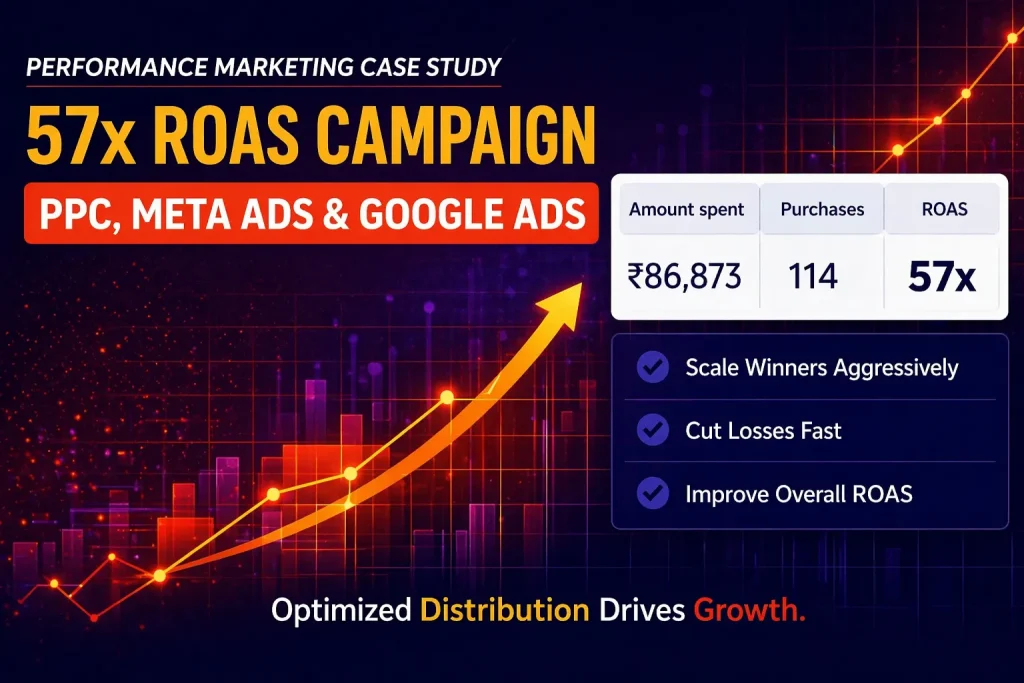
This account had a 57x ROAS campaign.
And still averaged just 4.84x ROAS.
Let that sink in.
One campaign printed revenue.
Others quietly diluted the entire account.
Same account.
Same setup.
So what went wrong?
This performance marketing case study by ROI Hunt, a results-driven performance marketing company, reveals why most D2C brands don’t fail because ads don’t work — they fail because they tolerate mediocrity across their PPC services, Meta Ads, and Google Ads campaigns.
The Objective
– Drive profitable website purchases using Meta Ads and Google Ads campaigns
– Maintain strong overall ROAS across PPC services
– Identify high-performing campaigns quickly
– Eliminate budget waste
– Build a scalable performance marketing system
The Challenge
– Mixed campaign performance across Meta Ads and Google Ads accounts
– One extremely high-performing campaign (57x ROAS)
– Multiple average and low-performing campaigns dragging results
– Budget spread across “okay” performers
– Misleading average ROAS masking inefficiencies
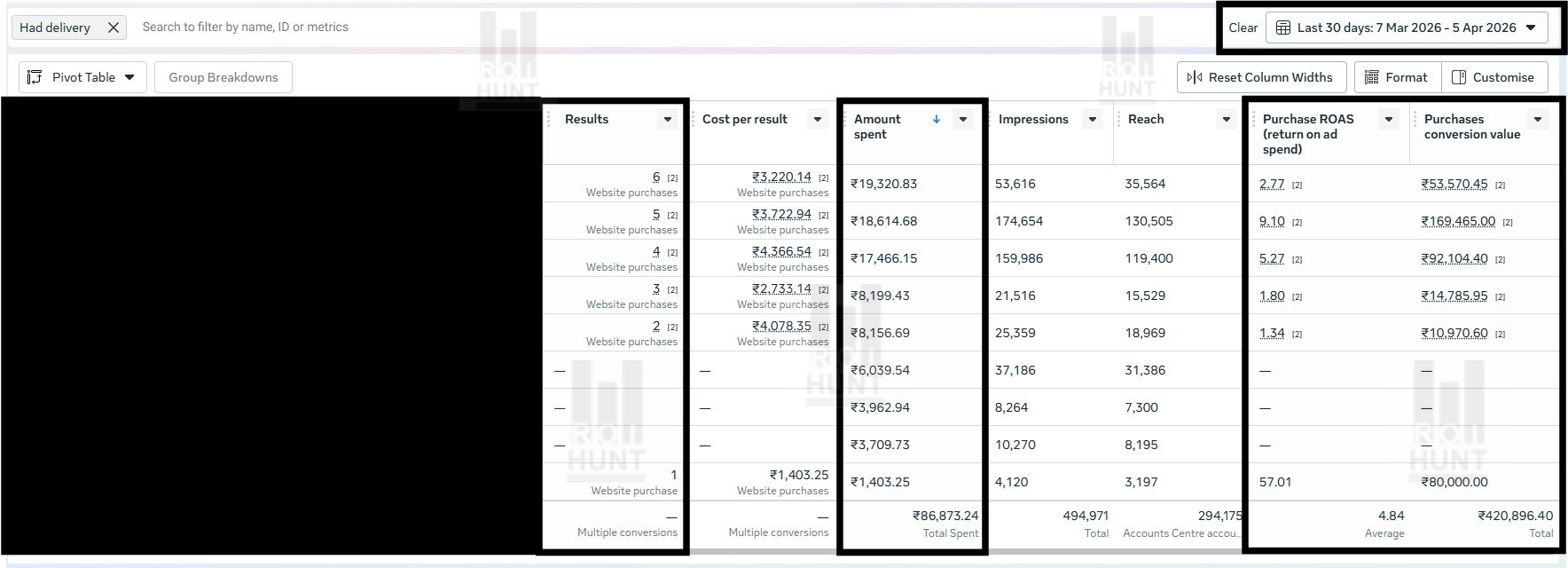
Performance breakdown:
– 57x ROAS (outlier winner)
– 9.1x ROAS (scalable)
– 5.2x ROAS (average)
– 1.3–1.8x ROAS (loss-making)
That’s not a platform issue across Meta Ads or Google Ads.
That’s a performance marketing decision-making issue.
The Strategy: Distribution Over Averages
1. Killing the Average ROAS Illusion
As a performance marketing company offering PPC services, Meta Ads, and Google Ads management, we don’t optimize for averages.
We focused on:
– Campaign-level profitability
– Revenue contribution per campaign
– ROAS distribution
👉 Because averages hide inefficiency.
2. Tier-Based Campaign Classification
Campaigns across Meta Ads and Google Ads were segmented into:
– Top Tier (9x+ ROAS) → Scale aggressively
– Mid Tier (4–6x ROAS) → Monitor & optimize
– Low Tier (<2x ROAS) → Cut fast
👉 Clear decision-making framework used by experienced Google Ads experts and performance marketers
3. Aggressive Scaling of Top Performers
Winning campaigns were:
– Given higher budget allocation
– Scaled in controlled increments
– Expanded strategically across PPC platforms
👉 Top 20% drove majority revenue
4. Eliminating Mediocrity
Instead of chasing new winners:
– Low ROAS campaigns were paused across Meta Ads and Google Ads
– Budget shifted to high-efficiency campaigns
– “Okay performance” was no longer acceptable
👉 Profit improved without increasing spend
5. Budget Reallocation System
– Daily performance tracking
– Spend dynamically shifted
– CPA and ROAS are strictly monitored across all PPC services
👉 Money followed performance — not assumptions
Results (Last 30 Days)
Performance Snapshot
– Total Ad Spend: ₹86,873
– Tracked Revenue: ₹4,20,896
– Average ROAS: 4.84x
– Top Campaign ROAS: 57x
– Mid Tier ROAS: 5.2x – 9.1x
– Low Tier ROAS: 1.3x – 1.8x
What This Means
– One campaign had massive impact on revenue
– Average ROAS masked inefficiencies
– Majority budget was being diluted across mid/low performers
– Profit improved by focusing on distribution
👉 Scaling in performance marketing isn’t about more campaigns.
👉 It’s about better allocation across PPC services, Meta Ads, and Google Ads.
Why This Worked
Distribution-Based Thinking
Focus shifted from averages → contribution
Aggressive Scaling of Winners
Top campaigns drove majority growth
Fast Decision-Making
Low performers were cut early
Budget Discipline
Spend aligned with profitability
System-Driven Execution
Applied by experienced performance marketing and Google Ads experts
Key Insight
👉 Average ROAS is a lie.
What actually matters is:
– Where your money is going
– Which campaigns are driving revenue
– How fast you reallocate budget
Conclusion
Most brands don’t lose because nothing works.
They lose because too many things are just “okay.”
– 9.1 ROAS → scale
– 5.2 ROAS → monitor
– 1.3–1.8 ROAS → cut fast
As a performance marketing company, ROI Hunt focuses on:
👉 Back your top 20% aggressively
👉 Eliminate mediocrity
👉 Let data drive every decision
Because performance marketing isn’t about running more ads.
It’s about making smarter allocation decisions across Meta Ads, Google Ads, and PPC services.